田田个展“画”
展览信息
前言Introduction
Quiet Paths, Reflected Light
——A Brief Discussion on the Evolution of Tiantian's Painting Text by: Yao Siqing Empty hills, no one in sight, only the sound of someone talking; late sunlight enters the deep wood, shining over the green moss again. ——Deer Fence (Burton Watson, translated in 1971, published in Chinese Lyricism)
In a 2016 poem titled Golden Serenity, Tiantian expressed her wish to paint “still life” and “landscape.” It was the most straightforward way of saying that the interior and exterior are her subject matter. For example, her studio-residence, where she’s been working and living for a decade, or Tuanjiehu Park, are frequent subjects in her work. Although the artist has offered an unusual way of seeing in these seemingly ordinary, real-life settings, through a carefully structured simplicity, she takes the viewer through deep, deserted passages where emptiness and silence act upon both sight and hearing, subtly echoing an old saying of Eastern aesthetics - “Tranquility brings far-reaching vision.”
Upon close observation, her images often feature thinly brushed, pale backgrounds or deliberate blank spaces; evenly diffused light pervades Tiantian’s pictorial world. Whether in horizontal or vertical format, her compositions are arranged from bottom to top in parallel planes, where the three-dimensional space unfolds like an open, flattened box. The gaze moves from a downward-facing ground plane to a middle distance, and finally meets the boundless sky above the canvas. If the painting depicts an interior, the artist frequently opens a path for the viewer’s eyes through doors and windows, breaking the boundaries of the wall and extending vision into imagined distance. In a work titled Nest, Tiantian paints herself lying on her small winter bed, gazing out the window at a bird’s nest on bare branches. Struck by empathy, she paints a small additional window in the upper left corner, where childhood “nest” in Xi’an comes into view. This blending of subjective and objective realms breaks the linear perspective of realistic space and evokes poetic imagery—
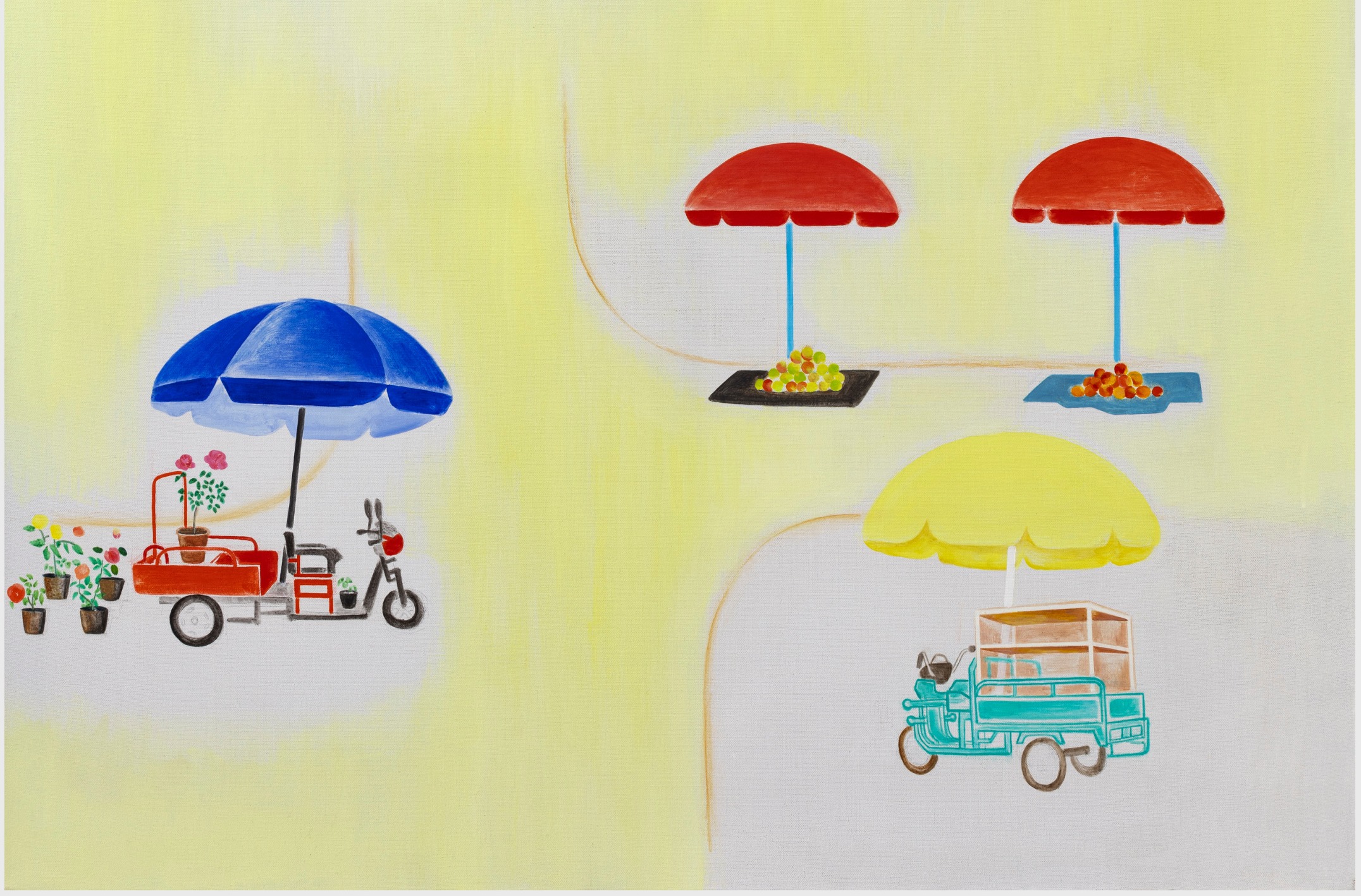
like the two-story Yellow Crane Tower, which, in the poet’s imagination, ascends infinitely. This kind of distant vision also appears in Landscape 2021, where the visible range extends from the bustling commercial center to distant suburban hills. Streets cut through buildings like rivers in a traditional landscape scroll. Sometimes, this sense of distance manifests temporally rather than spatially, as in Spring·Summer, where the interior remains still, while spring and summer coexist through a glass door. All are cherished moments in the artist’s memory; inside, only a single diagonal black line hints at spatial depth. This concise black line reappears later in other works, such as Street Scene, as a visual signifier of emptiness and solitude. In these works, objects existing on the same plane are rendered with nearly equal intensity. Human subjectivity dissolves into things, present only as a gaze that drifts freely through space and time. They resonate with Wang Wei’s poem, Deer Fence, “Empty hills, no one in sight, yet voices echo; sunlight returns into the forest, shining on moss again.”
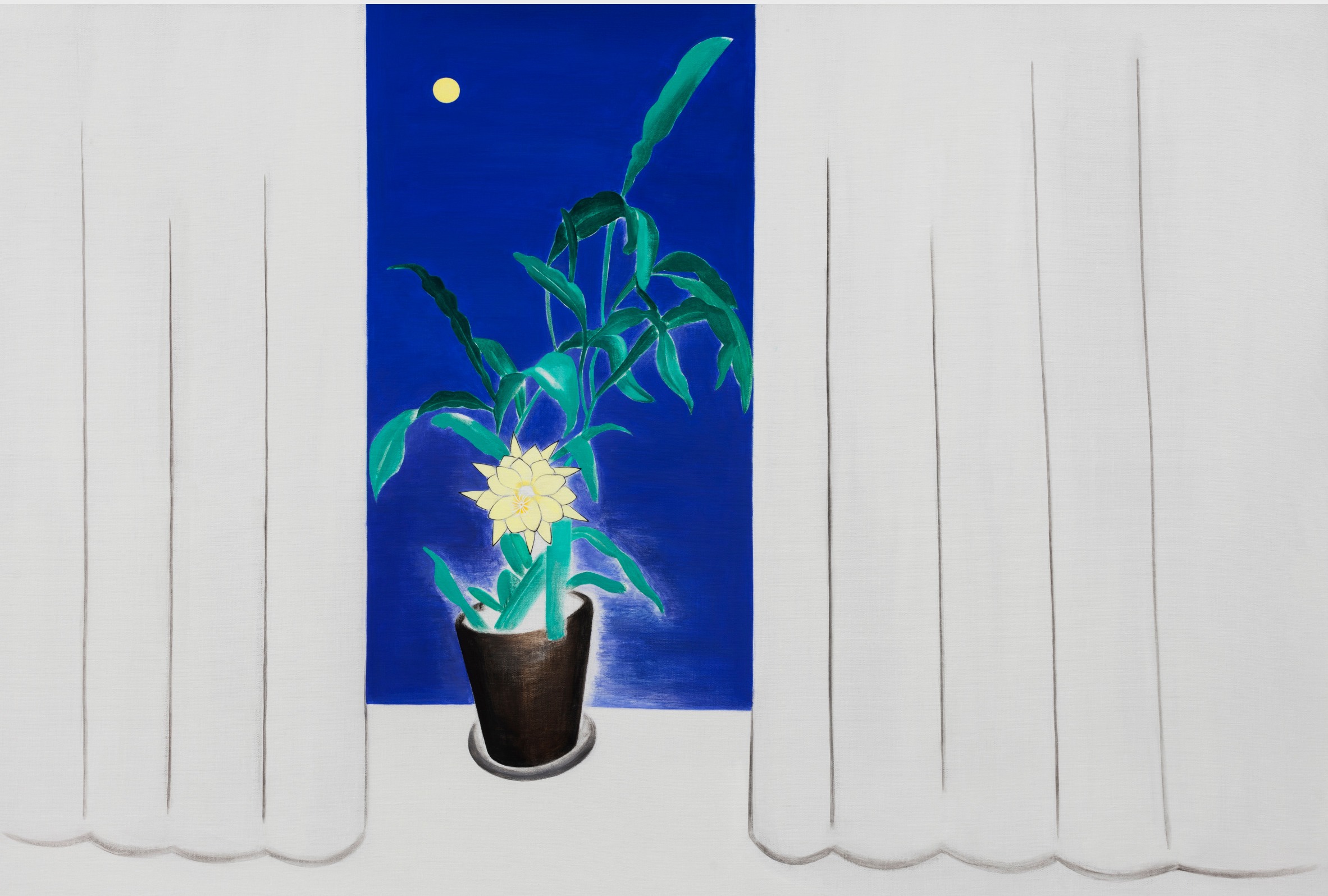
If the dissolution of boundaries between still life and landscape was the polemical realm Cézanne opened—from apples to Mont Sainte-Victoire—then Tiantian, through her explorations from 2016 to 2025, is gradually finding her own resolution. Using geometric reductions—squares, triangles, and circles—and underlying grids of intersecting lines, she distributes balance across the pictorial field. These methods, alongside her muted palette, endow her paintings with a sense of serenity and stability—unquestionably a gift of modernism. At the same time, we would also notice the influence of Chinese landscape painting, especially in spatial organization. The principle of pingyuan (“leveled distance”) among the “three distances” in classical theoryappears repeatedly. In Yuan Dynasty handscrolls, the viewer’s gaze shifts gradually as the scroll unfolds. In Tiantian’s canvas, such migratory vision is condensed through expanses of blank space. Particularly in Epiphyllum, black lines and voids create a curtain that is neither real nor illusory, occupying two-
thirds of the canvas, while the moonlit epiphyllum glows within a deep blue vertical plane. The path that leads toward the sky is suffused with nocturnal fragrance, lasting through the night; the blank space amplifies this synesthetic unity—
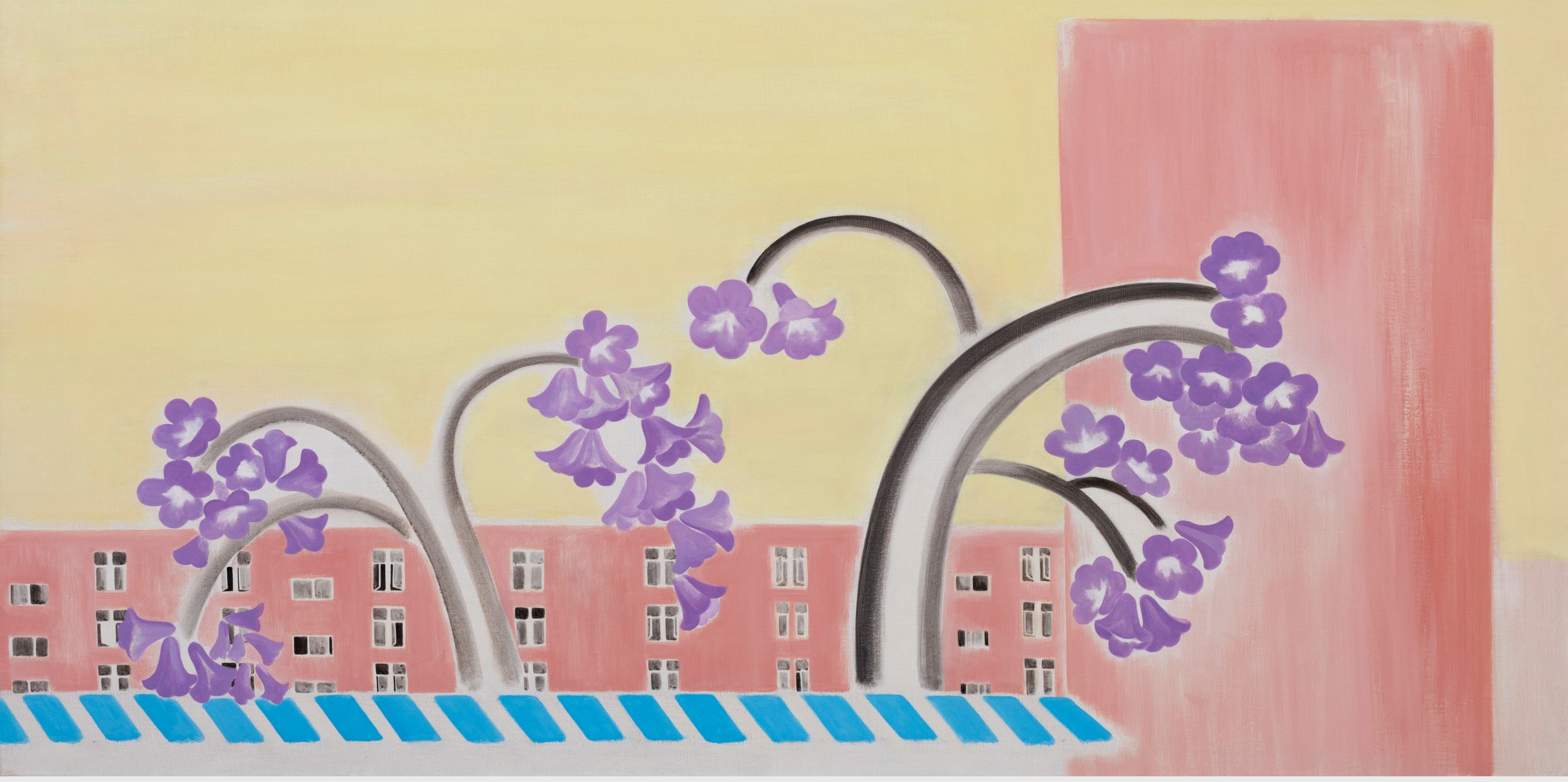
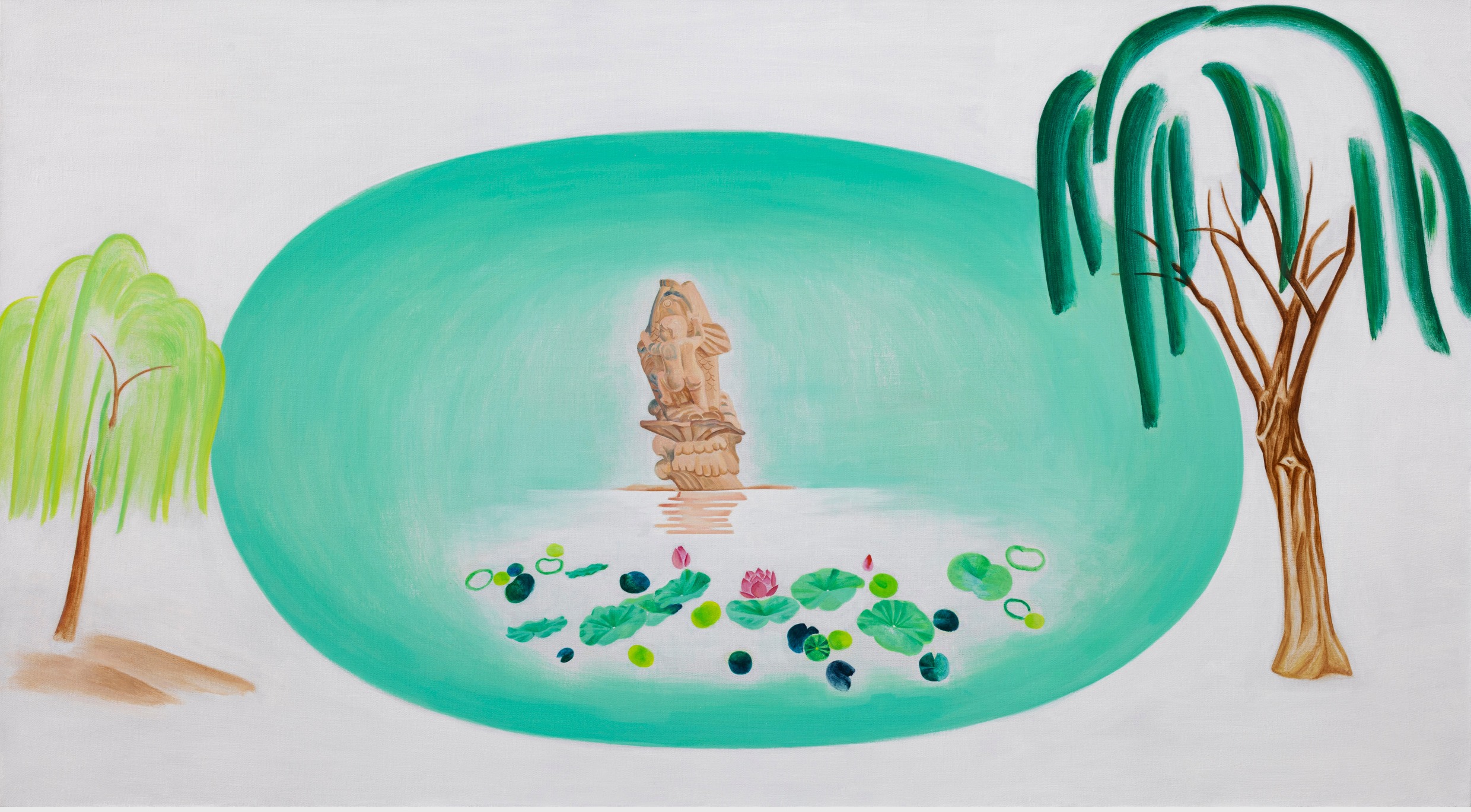
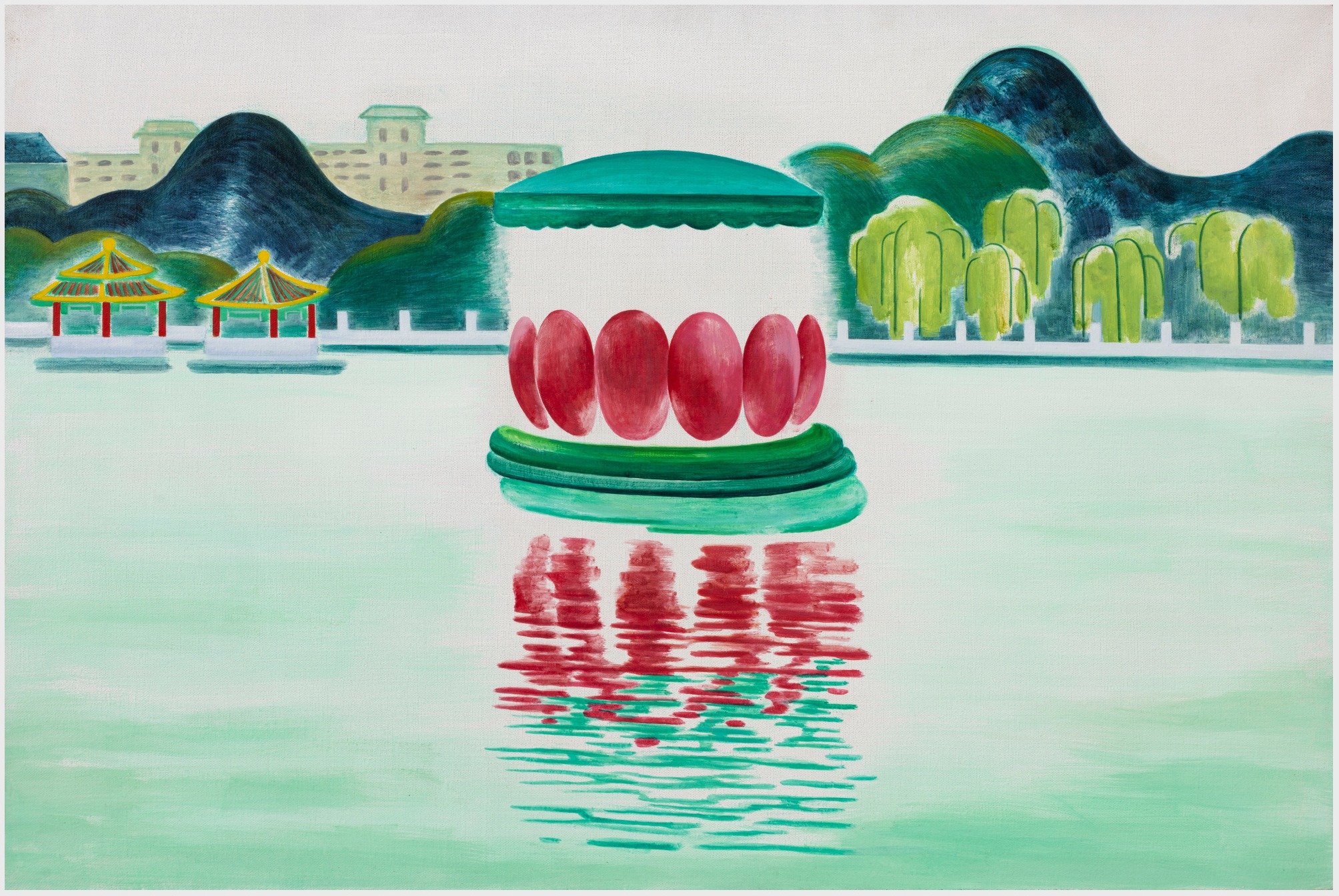
luminosity, clarity, and scent blend together. Beyond its stunning beauty, the epiphyllum carries profound cultural meaning. As stated in the Lotus Sutra, “The Buddha told Śāriputra, this marvelous Dharma is spoken by the Tathāgatas only at certain times, like the epiphyllum flower that blooms but once in an age.” The dialectical unity of change and constancy is thus embodied in the flower’s symbolism. This recalls Wang Wei, the painter-poet known as the forefather of Chinese landscape painting. His poem On Painting writes, “Spring has gone, yet blossoms remain; people have arrived, yet birds are unalarmed.” A practitioner of Zen Buddhism, Wang Wei sought to perceive the eternal through transience, preserving it in both poetry and painting. Through meditative contemplation, he heightened his perception of subtle phenomena and expressed, through simple visual language, how things come to be seen. It is through this Buddhist view of emptiness that Tiantian’s thought converges with Wang Wei’s. For instance, she once copied the couplet “A lonely plume of smoke straight in the desert sky; the setting sun round upon the long river” (Envoy to the Frontier) on a scrap of paper—her modernist training instantly grasped its abstract image and chromatic resonance. One cannot help recalling how, through the 20th and 21st centuries, East–West encounters of cultural curiosity led to translations from Fenollosa and Pound to the Beat generation. Wang Wei became one of the most studied Chinese poets in the West. Through this distanced gaze, his poems were translated again and again; their aesthetics—distinct from the European tradition—were absorbed by poets in the Americas. Through the diminishment of subjectivity, they discovered spiritual simplicity and luminous emptiness. Dozens of translations of Deer Fence have circulated, carrying this refined sensibility outward and back again, rejuvenating an ancient poetic land with new blood. Tiantian’s paintings seem to echo this resonance. When our gaze passes from yellow and pink lilies on a table to the green mountains on a hanging scroll; when it lingers on cradle-like lotus boats mirrored in water, or on a singular willow tree; when Tiantian speaks of discovering truth through Chinese system of color and the pictographic formation of written characters—and paints paulownia spring blossoms in “Han purple,” whose instant vibrancy turns to serenity; when, the ginkgo trees thrive in abundance outside, while the gourds and fruits ripen in plenty, and a plush tiger sits cross-legged in Autumn, bright orange and unmoving, as if having subdued its desires— all these evoke Wang Wei’s transformed vision through faith.
参展艺术家Artists
作品