呱呱猫与花花狐
展览信息
前言Introduction
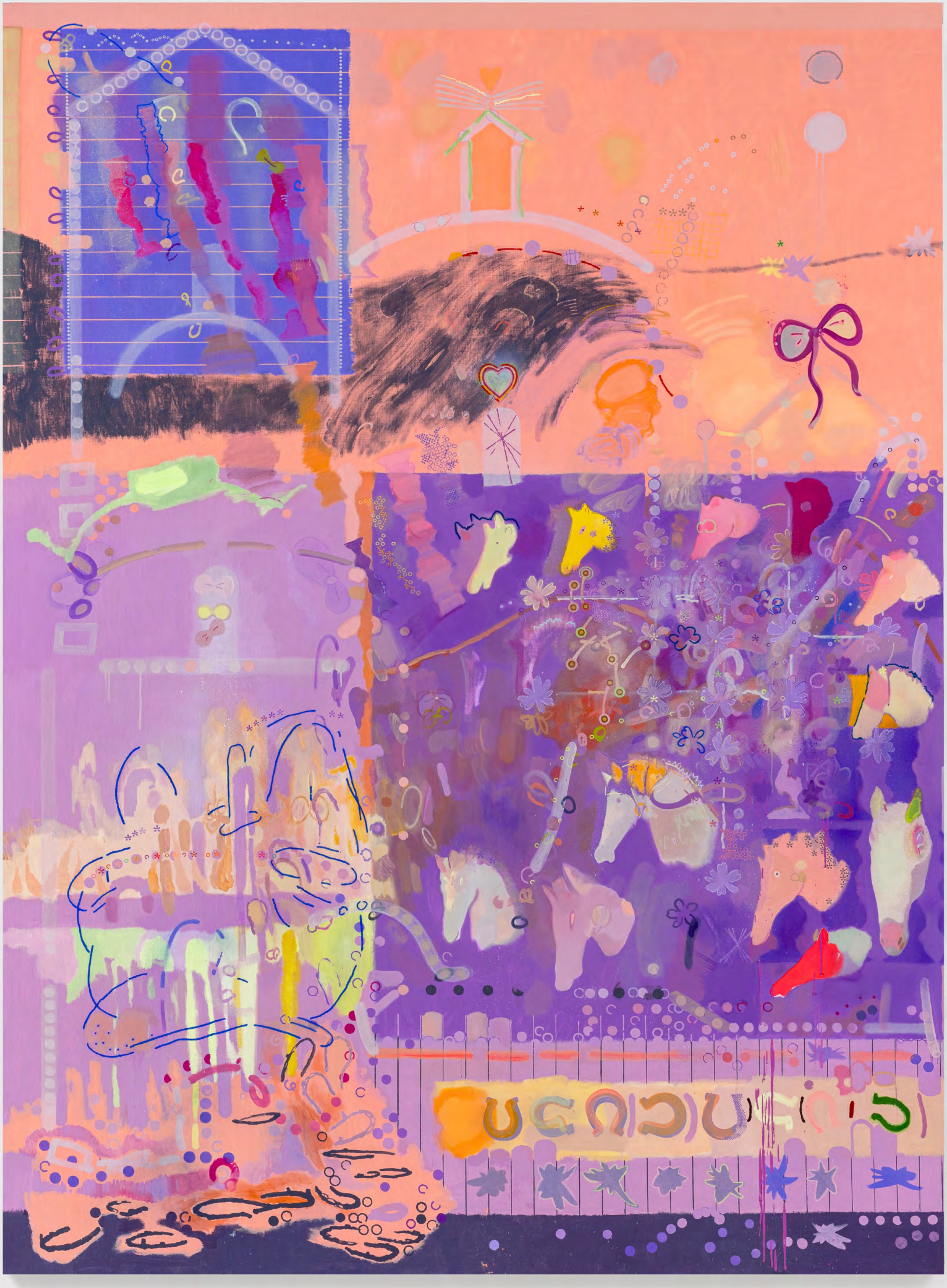
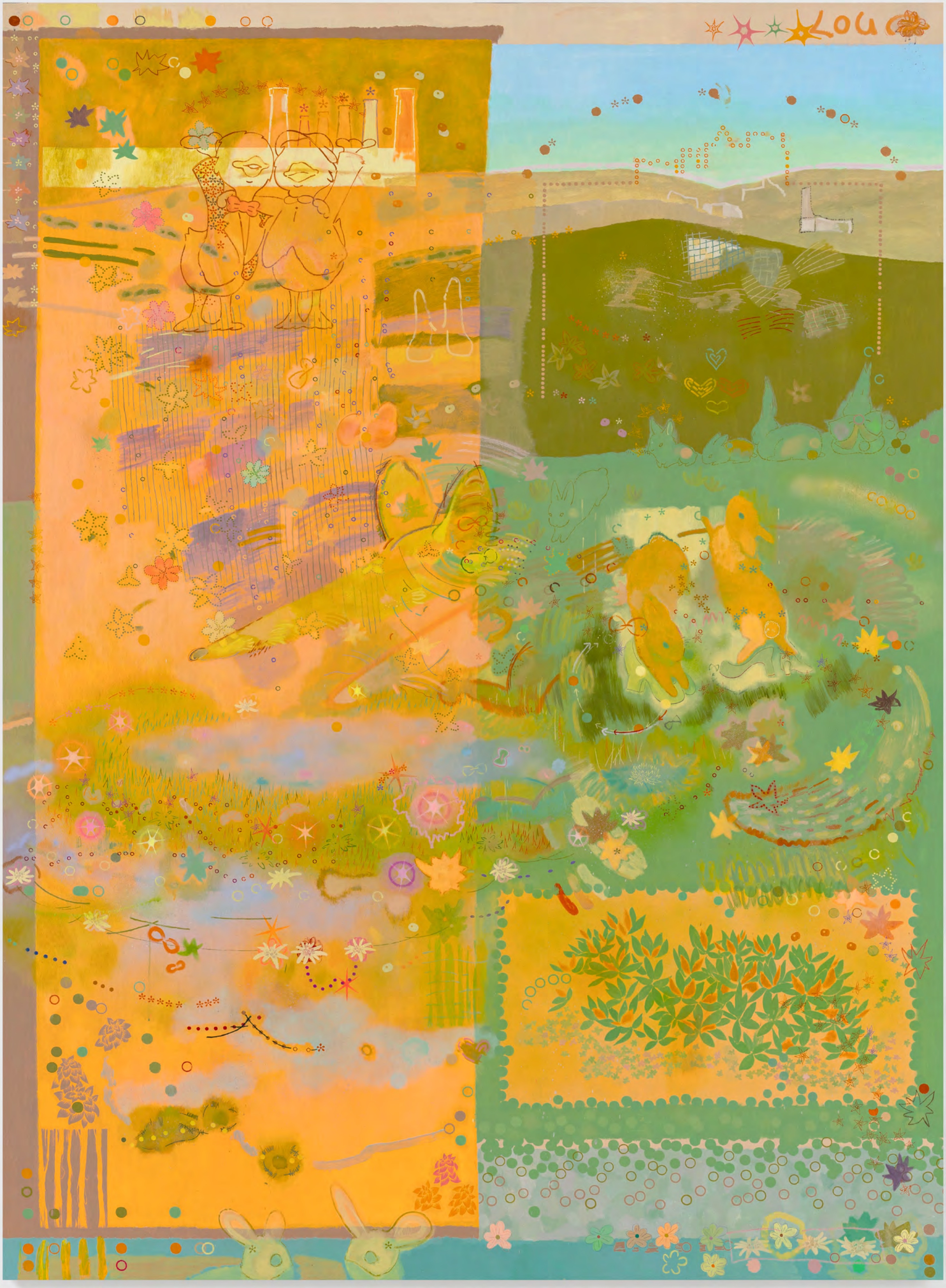
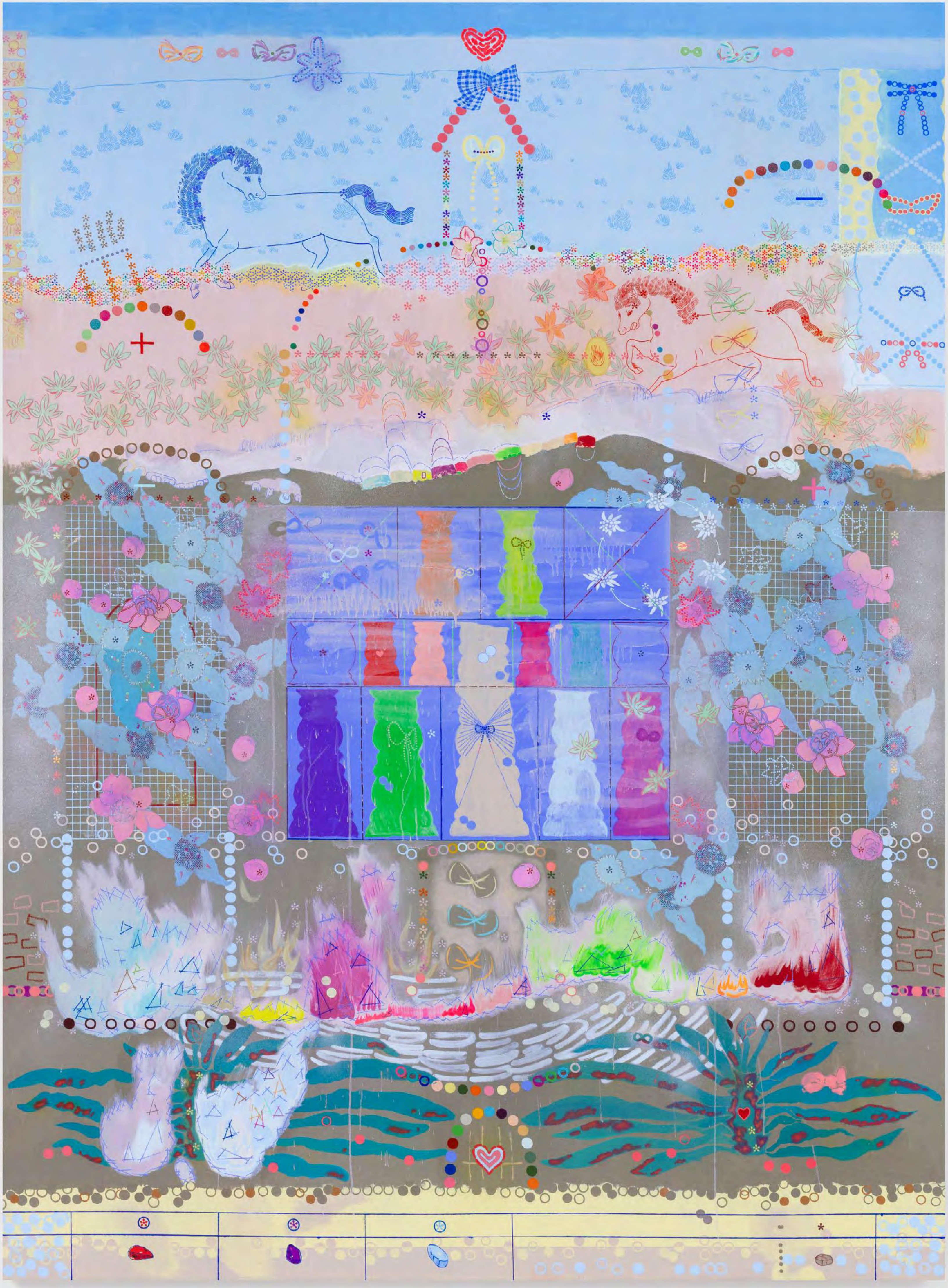
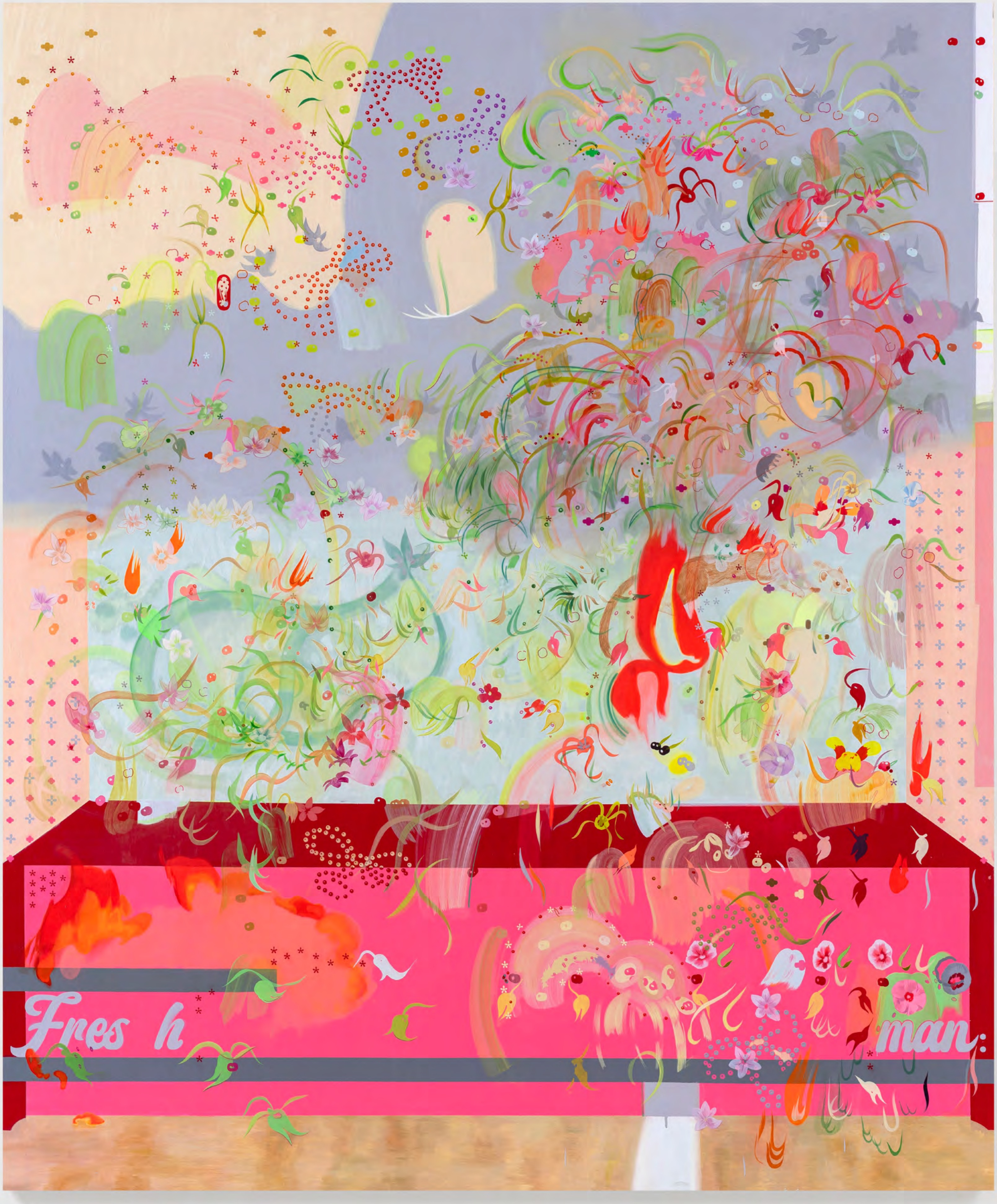
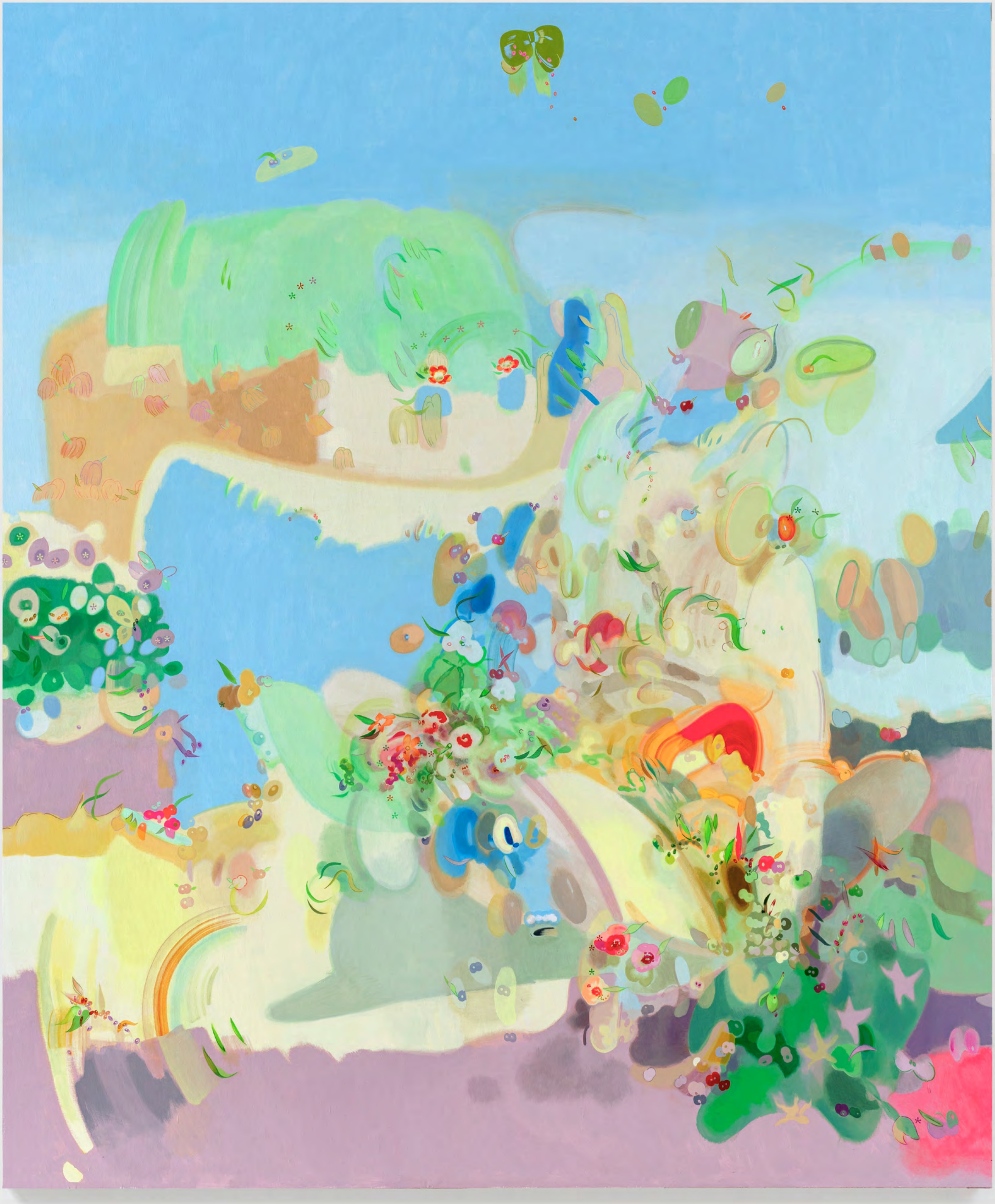
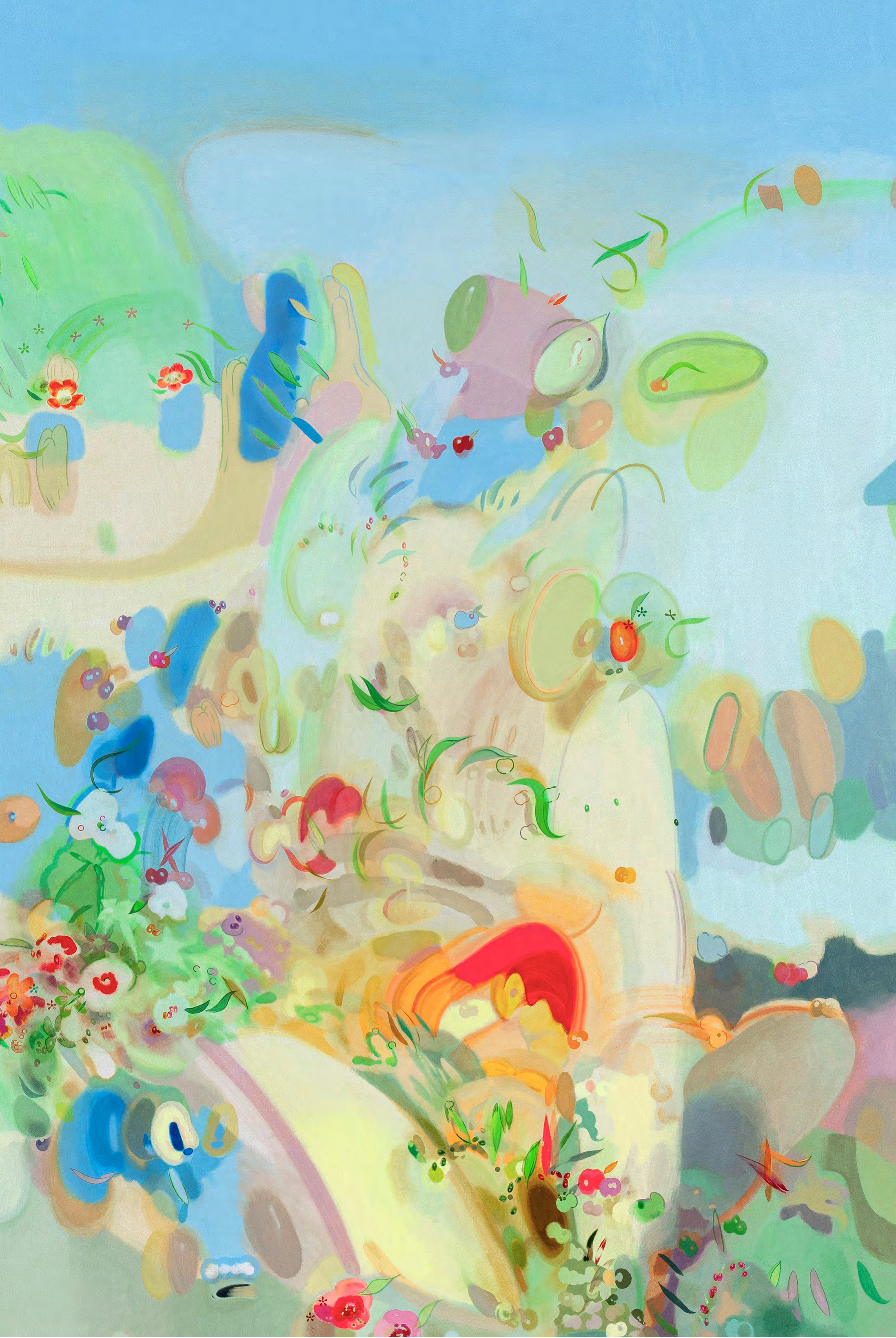
“呱呱猫与花花狐”,把这几个字准确地念出来可能需要一点耐心。当然,这小小的拗口并不是本展览设置的恶作剧。你再体会一下,嘴巴几次打开又收紧,重复的元音响亮而圆润,对称的结构形成歌谣般的韵律,牙牙学语的孩子大概也会喜欢。呱呱猫与花花狐,也许你会感觉在张嘉蕾的画中找到了它们的踪迹,又或者它们并不存在——这不重要,本展览无意新造物种故作萌态(尽管这些作品的确会产生令人愉悦的效果),重要的是,暗含着音乐感的拟声词“呱呱”和具有极繁美学色彩的形容词“花花”分别与动物意象拼接在一起,在碰撞的边缘所激起的张力和想象空间。呱呱猫与花花狐,请再默念一遍……你已经掌握了进入张嘉蕾创作世界的咒语。张嘉蕾的作品尺幅并不小,尽管如此,这个饱满的世界仍在溢出中。由色块和硬边线条构建的界限分割着画面,而跃动于其上的“零件”不断越界,甚或累积构建起新的轮廓边界,像是生物受到某种驱动力后的自动聚集。因此即便它们如空游无所依般悬浮于底色之上并呈基本均匀的分布,整体画面仍充满有机的动能。此外,去中心化构图和高密度的设置,让画中元素不断冲击着布面边缘,它们已然因不受这方天地的支配而感染了画外的空气。再者,每个具有轮廓的单体都不乏笔触细节,这使得观看距离被拉近,观者的目光沿着单体之间聚散而成的若有似无的路径进行视觉寻宝,并最终在色彩的折返中得到迷失的满足。张嘉蕾以这种策略性的“过度”,重拾被技术所剥夺的情感温度。如果说,当下信息极度饱和的生活方式本质是利用算法在无数次推演后得到最优解,那么张嘉蕾将内容具体化为细节本身,以不厌其烦的个体劳动将复杂性和盘托出,在弯弯绕绕中铺垫喜悦与惊奇,即是一种微妙的抗衡。溢出感同时强化着张嘉蕾作品中的平面性。平面化的处理在《复眼》系列中尤为突出,一方面,她从册页、书签等形式中提取了平面元素,为画面构建基础的视觉框架;另一方面,以平面化的方式将外部世界进行转译、筛选,可以为尽可能多样的内容保留足够的信息,因此你可以看到,张嘉蕾不拘一格地调动起各种平面技法,笔下出现了类似中国画白描风格的马、迪士尼卡通风格的鸭子、丝网印刷风格的植物以及更多埋植于民艺图案、装饰纹样中似曾相识的形式。在此,艺术家无意追溯这些视觉经验的源流或质询它们在风格语义层面的碰撞,而是意在强调离散的图像、特征与经验如何在穿插与叠加中形成新的信息形式,以及它于心理层面产生的复杂体验。
“画蝴蝶结的时候,我是把它当成人工的蝴蝶在处理,对我来说它不是完全的死物。”张嘉蕾说。当一件事物不再属于自然,又脱离了人造物的实用语境,张嘉蕾得以在这一中间地带找到充分发挥的空间。而当事物被平面化为某种符号化的 “原型”,它们所在的画布也因此成为了外部世界与自我世界相遇的界面,由此,画上的花朵、草地、不具有攻击性的动物和如积木般搭建起的房屋,得以成为一片不被侵扰的心灵安全地带,或者柏拉图理论下的理念世界。将事物归纳为符号的倾向,让张嘉蕾反复描绘同一类对象,它们不断演化、提炼,在具象与抽象间变呱呱猫与花花狐策展人:朱文琪
2025.11.01-2025.12.07
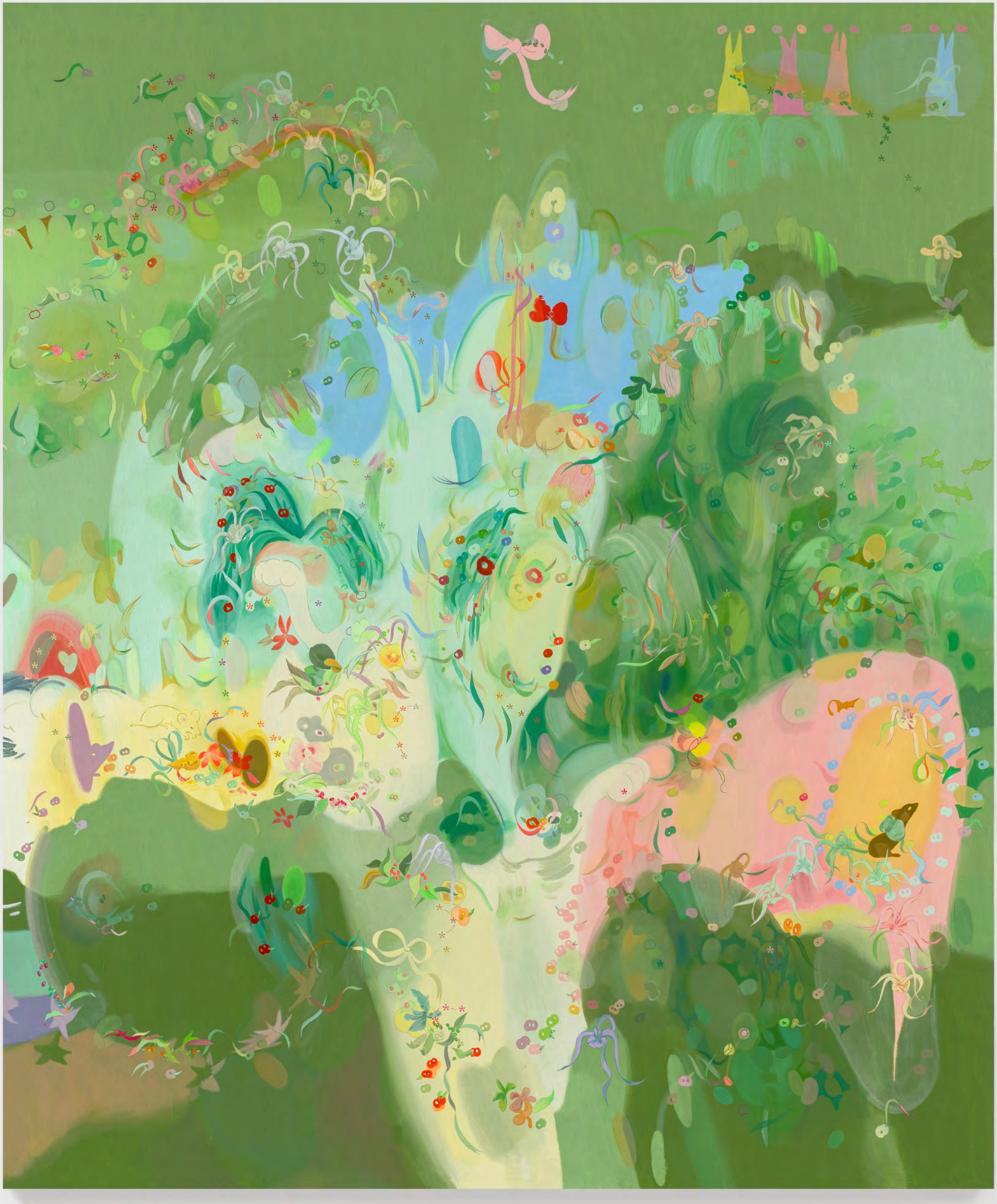
形。比如,一段上升后又下降的弧线笔触,在《兔子蛋》中表现为夹竹桃的叶子;《卵》中则是蜘蛛兰花瓣、低垂的眼帘,以及状若烟花或垂柳树的形状;在《Freshman》中则出现了更多,甚至
“Freshman”的字符形态也是这样。如康定斯基所言,“即使完全抽象的形式,它们也拥有自己的内在共鸣,是一种精神性的实体"1,张嘉蕾的画面上连续跃起的弧线正如一段轻巧灵动的音乐中回旋的“主导动机”,并在变奏中不断强化给观者带来的振荡。相似的语言还有《复眼》中的正圆形,如标点厘定着文字叙述的表意和张弛,这些圆形亦是画面节奏的标示。它的高度概括性使它在不同的画面中都有各自的解读可能和变形空间,在《Freshman》中它是樱桃、在《卵》中则是状若虫卵或细胞的椭圆形。这种连贯与模糊对观者来说既是迷惑也是指引,诱使视觉在大形带来的宏观把握和细节引发的微观联想之间反复跳跃。因此,“呱呱猫与花花狐”是一场天真的游戏,也是一处充满生机的花园。当这些作品还在工作室里生长时,张嘉蕾不断地为它们添加细节,如同在花园里耕作。如果说,创作是一种治愈性的度过时间的方式,我们希望你在展览的曲折小径里,在一屏屏呼之欲出的风景里,获得与这种治愈的共鸣。
1[ 康定斯基. (2011). 《艺术中的精神》. 杜澐, 译. 重庆:重庆大学出版社]
The Chinese title, “ 呱呱猫与花花狐” (GUAGUA Cat & HUAHUA Fox), plays like a tongue twister or a nursery rhyme—a playful, incantatory prelude to the visual spell cast by Zhang Jialei’s paintings. Much like the magical word "Abracadabra" itself, which holds no literal meaning but possesses the power to ignite the imagination, this exhibition as a whole constitutes an act of "Abracadabra-
Overflow"—where incantation gives way to a prolific, spilling forth of forms and sensations. Let the spell linger on your lips once more... and you shall find yourself within the charmed realm of Zhang Jialei's creation. Zhang’s works are not modest in scale, yet the world they contain persists in a state of overflow. The boundaries constructed by colour blocks and hard-edged lines divide the picture, while the " components" leaping across them, which at times accumulate to form entirely new contours - a convergence reminiscent of organisms driven by some vital impulse to instinctively coalesce. A decentred composition and a high density of elements amplify this energy, allowing the painted forms to constantly press against the edges of the canvas, charging the very air beyond the frame. Furthermore, each silhouetted form is rich with brushwork detail, pulling the viewer’s gaze into a visual treasure hunt along the seemingly endless paths formed by their clustering, ultimately finding a satisfying disorientation in the folds of colour. With this strategic "excess," Zhang Jialei restores the emotional warmth stripped away by technology. If the essence of our contemporary, hyper-saturated lifestyle lies in leveraging algorithms to deduce an optimal solution through endless calculations, then Zhang Jialei's approach - materializing content into tangible details and employing relentless, individual labor to lay bare complexity, planting moments of joy and wonder within every twist and turn—stands as a subtle yet potent form of resistance. T h e se n se of ove r f l ow s i m u l ta n e o u s l y reinforces the flatness in Zhang Jialei's works. The treatment of flatness is particularly prominent in the Compound Eyes series. On one hand, drawing from the graphic flatness of forms like bound albums and bookmarks, she builds the painting's foundational visual framework.; On the other, this flattening of the external world through filtering allows for the retention of enough amounts of information, accommodating a remarkable diversity of content. Therefore, Zhang Jialei has used various graphic techniques in an unconventional way, and her works appear as horses in traditional Chinese painting style, ducks in Disney cartoon style, plants in screen-
printing style, and forms that similar to folk art or decorative patterns. Her intention is not to trace the origins of these visual experiences or to interrogate their stylistic collisions, but rather to emphasize how discrete images, features, and experiences, through their interlacing and superimposition, generate new forms of information and the complex psychological experiences they trigger.
“When I paint a bow, I treat it as an artificial butterfly—to me, it is not entirely inanimate,”
Zhang Jialei has remarked. She finds her creative space in this intermediate zone ,where The Abracadabra-Overflow CURTOUR : kikizhu
2025.11.01-2025.12.07
objects no longer belong to nature yet are divorced from the utilitarian context of man-
made things. And when things are flattened into certain symbol "prototypes," the canvas becomes an interface where the external world and the inner self meet. Thus, the flowers, grasses, non-threatening animals, and block-
like houses can become an sanctuary of the soul, or a realm of ’form’ in the sense of Plato’s theory. The tendency to reduce things to symbols led Zhang Jialei to repeatedly depict the same category of objects, which continually evolved and refined themselves, morphing between figurative and abstract forms. For instance, an arc-like stroke that ascends and then descends manifests as oleander leaves in Rabbit Eggs; in Eggs, it becomes spider orchid petals, drooping eyelids, and shapes resembling fireworks or weeping willows; in Freshman, it appears even more frequently, extending to the very form of the word “Freshman” itself. As Kandinsky observed," Form itself, even if completely abstract, geometrically abstract, has its own inner resonance... "1, Zhang Jialei's continuous leaping arcs function like a “leading motif” in a light, agile musical piece, reinforcing the oscillating effect on the viewer through variation. A similar language is found in the perfect c i rc l e s o f C o m p o u n d E y e s . M u c h l i ke punctuation marks that define the meaning and rhythm of textual narration, these circles also serve as markers of the painting's rhythm. Their high level of abstraction allows for diverse interpretations and transformative possibilities across different works: in Freshman , they become cherries; in Eggs, they take the form of oval shapes resembling insect eggs or cells. This blend of coherence and ambiguity both confuses and guides the viewer, compelling the gaze to oscillate between the macro-level grasp offered by large forms and the micro-
level associations triggered by details.
“The Abracadabra-Overflow” is, therefore, both an innocent game and a vibrant garden. While these works were still growing in the studio, Zhang Jialei continuously added details to them, much like gardening. If creation is a healing way to spend time, we hope you find resonance with this healing as you wander the winding paths of the exhibition, amidst screens of landscapes that seem to leap off the page.
[1]: Kandinsky, Wassily. Concerning the Spiritual in Art. Translated by Michael T. H. Sadler. New York: Dover Publications, 1977. p. 32.
参展艺术家Artists
作品