影子先至,立于台前
展览信息
前言Introduction
Shadow before Form: Seeing Lags Behind Being Seen Gaius Plinius Secundus (Pliny the Elder)’s anecdotal accounts in Natural History of painting’s origins disclose a primal motive in image-making: one legend has it that a young woman, wishing to preserve the silhouette of her lover, traced the shadow he threw upon a wall; another holds that painting began when a beautiful youth, enraptured by his reflection in the water, drowned and became a narcissus. Both origin stories converge on a common theme: painting is born of a pursuit of elusive images. Cao Kuo likens his pursuit of “a sense of reality”
to chasing his own shadow. As he has said, the closer a painting comes to verisimilitude, the more the real seems to recede; only when he lays down his brush does the “shadow”
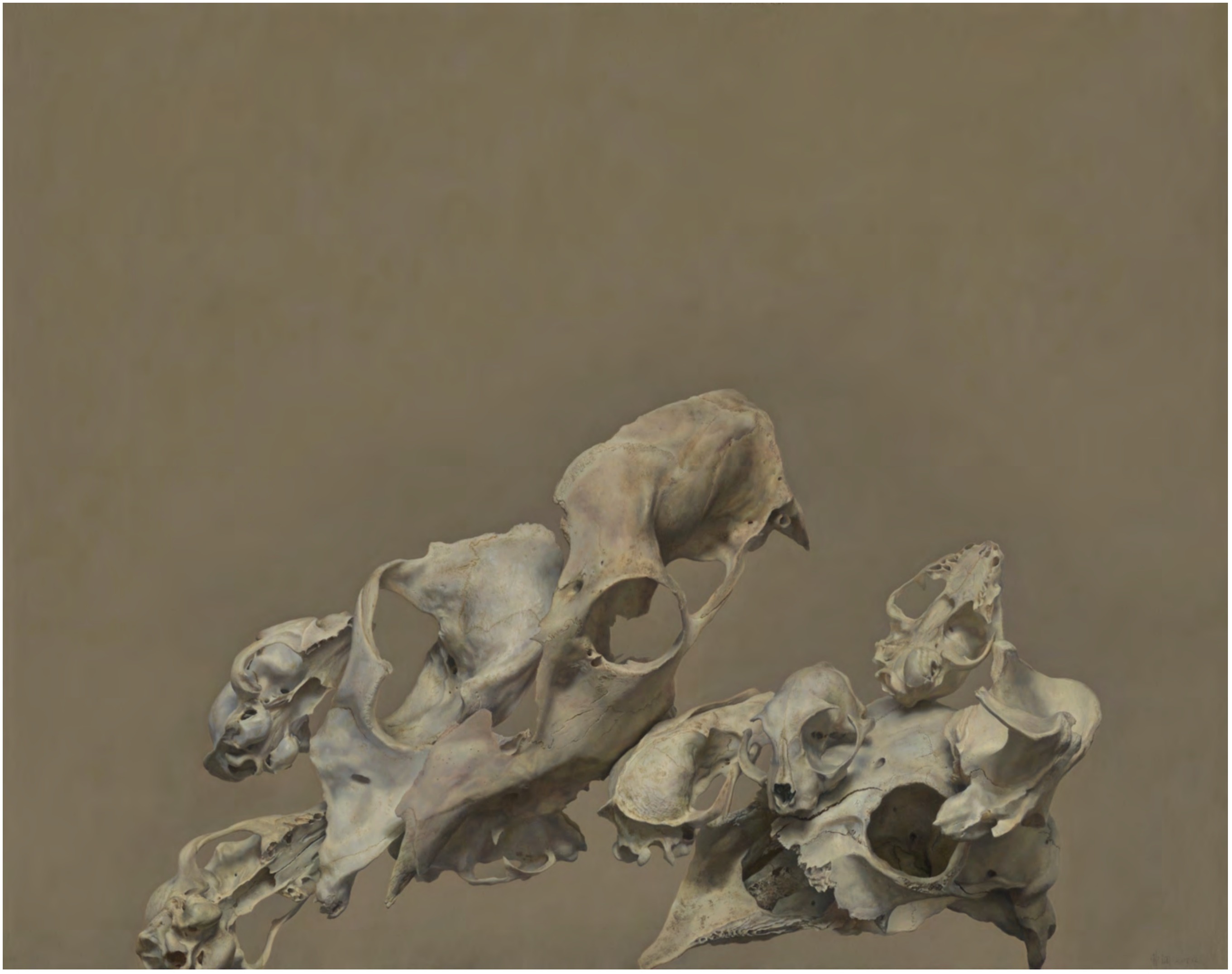
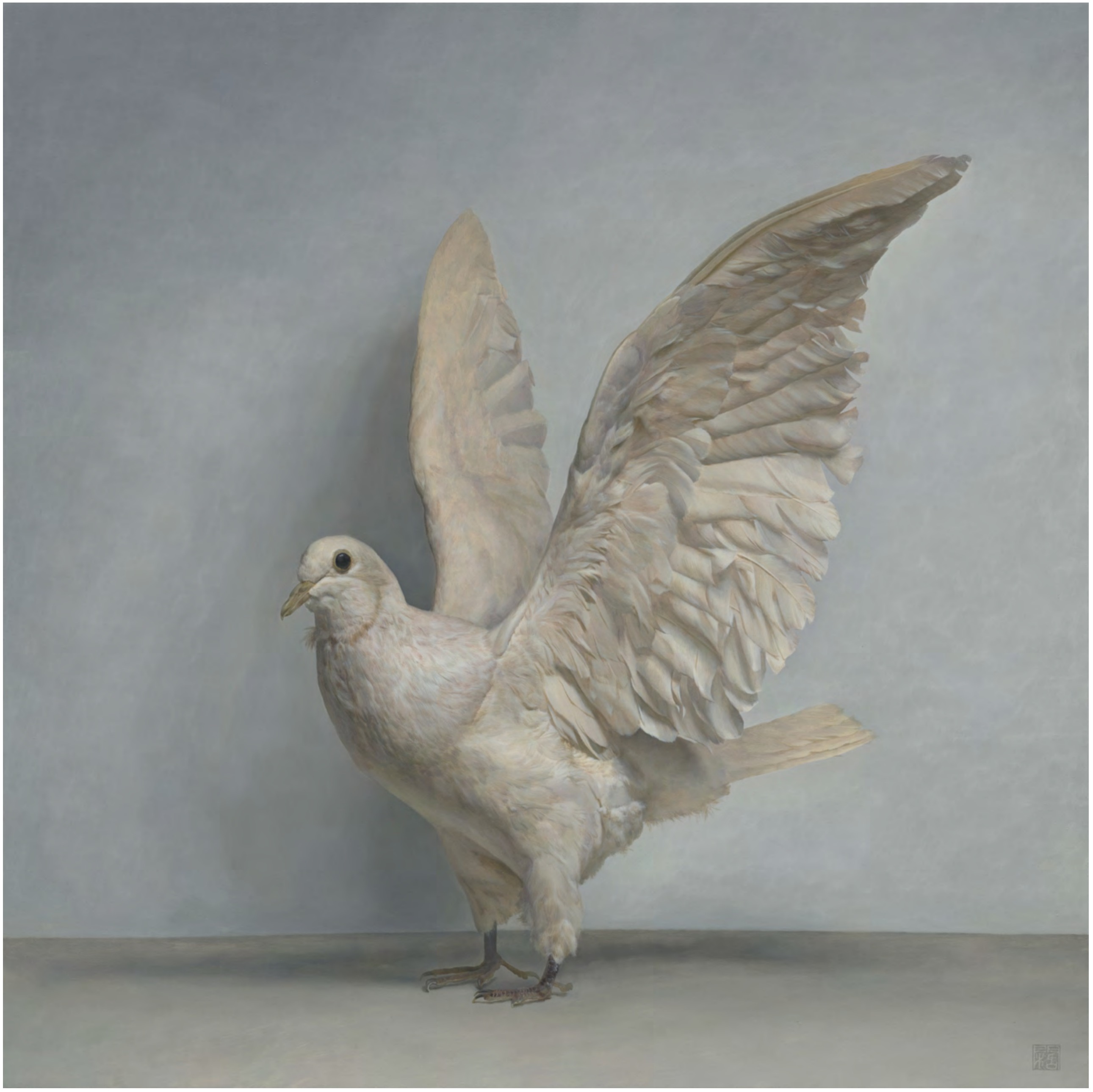
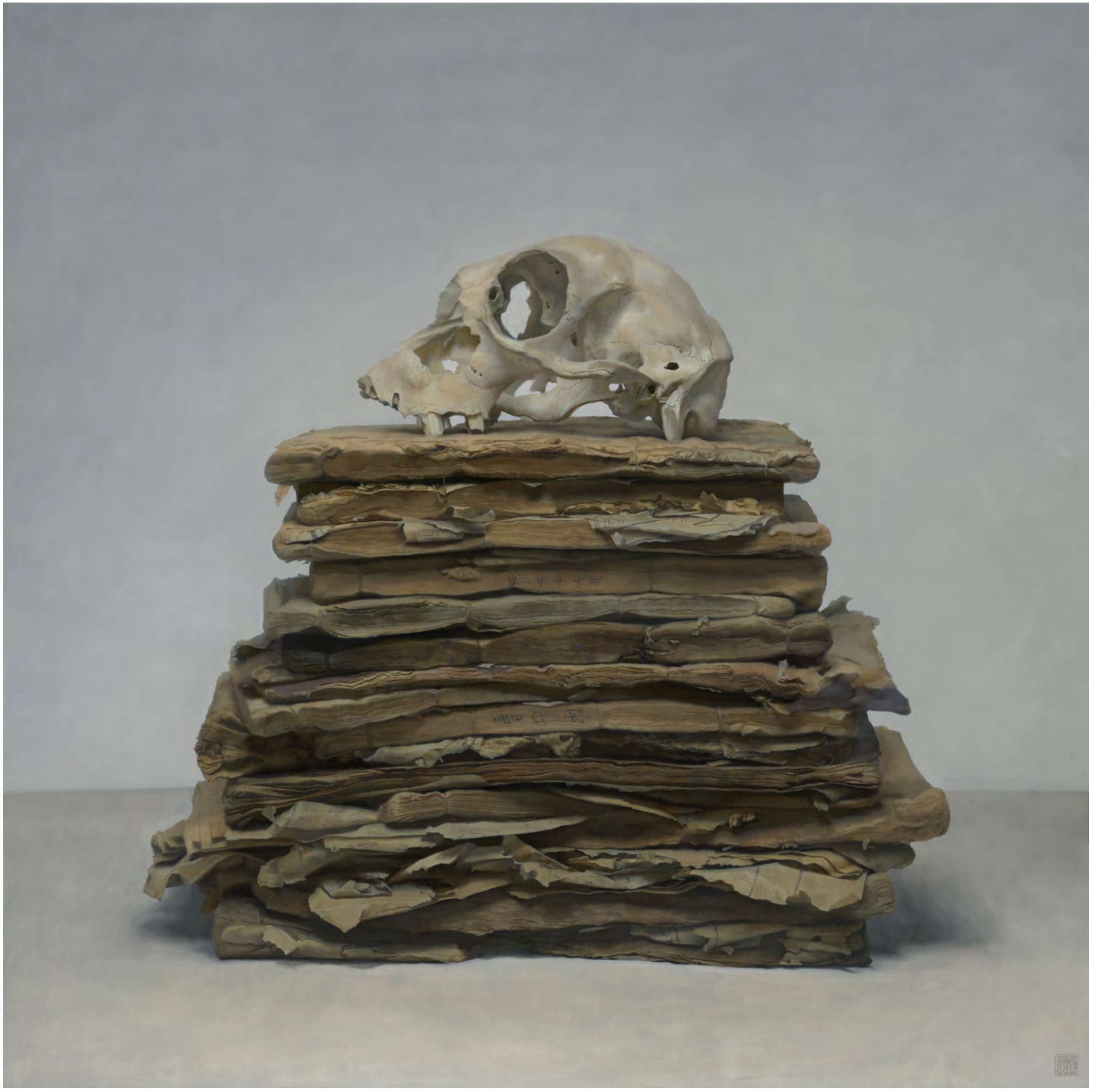
appear at his feet. His practice is therefore an ongoing meditation on reality, which he does not equate with objective reproduction but understands as a presence—an experiential immediacy in which the viewer can sense the being of an object. The shadow metaphor articulates Cao’s working insight: reality is never a terminus but an endlessly renewed quest. Working in an austere, scrupulous realism, Cao stages taxidermied birds and fragments of Taihu rock against fields of red velvet, composing still-life scenes endowed with theatrical resonance. In an era saturated by digital imagery, he insists on direct observation and working from life in the studio: light, layered tone, minute detail, and the very breath of the object are treated as subjective registers that photography cannot fully substitute. “Even the most hyperreal painting retains the painter’s subjectivity,”
he notes; each work therefore arises from a silent scene the artist has himself observed and painstakingly directed—light, depth, and gradation orchestrated. Thus “The Shadow’s Prelude” gestures toward the reciprocal project of painter and viewer: together they negotiate a spectrum in which the real and the illusory, the tangible and the phantasmatic, continually slide into one another. The exhibition title—The Shadow’s Prelude:
Thresholds of Presence and Performance—
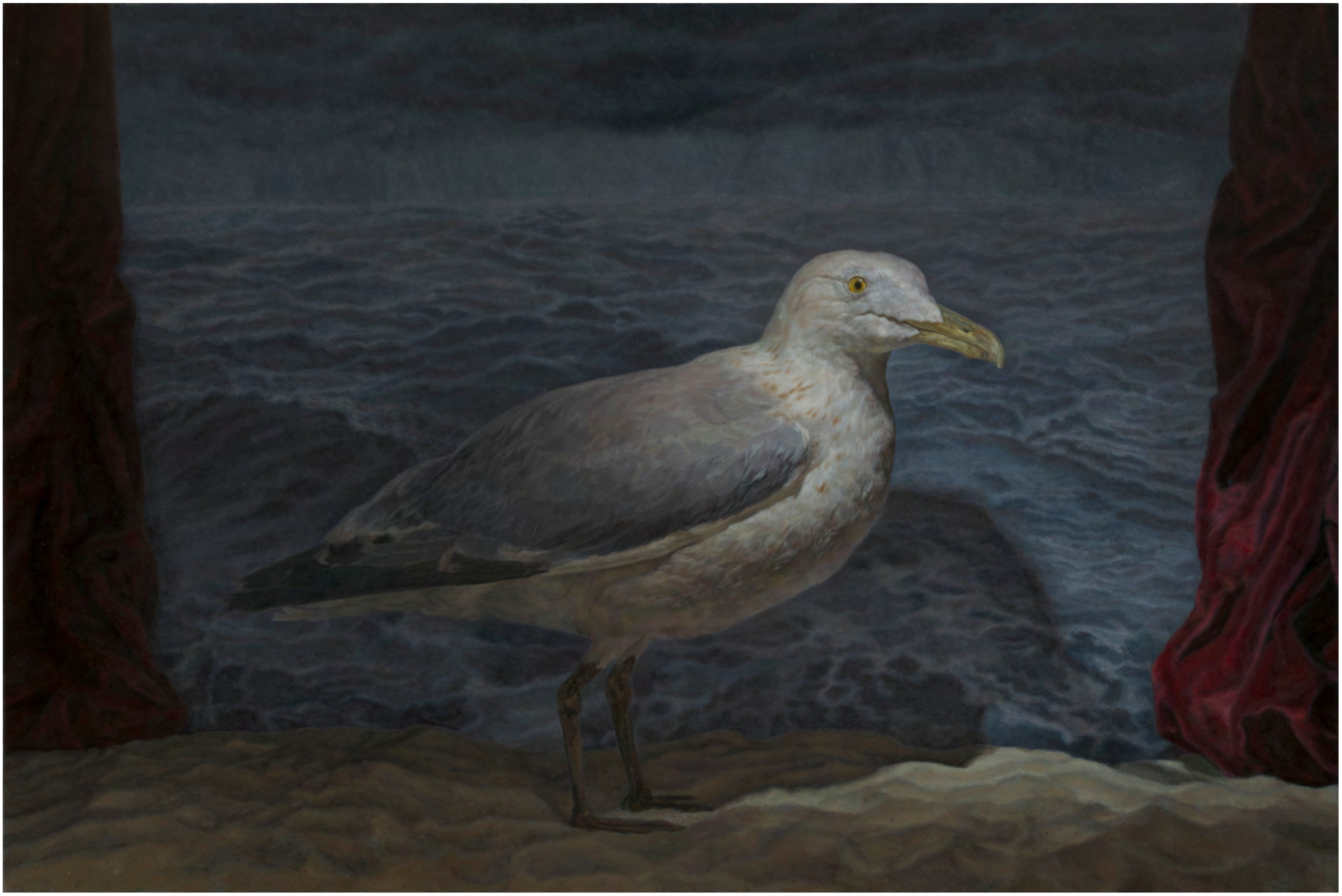
also signals the historical vocabulary mobilized across Cao’s oeuvre. Repeated motifs—the red velvet drape, taxidermied birds posed in their
“optimum” attitudes, rocks and cloud-forms staged as if on a set—construct a field that is simultaneously familiar and dislocated. The curtain derives from portraiture’s tradition—
where sumptuous drapery asserts status and rituality—and from the theater’s proscenium—
where the opening of the curtain delineates the relation between stage and spectator. Cao transposes these historical tropes: he does not treat taxidermy as natural-history display but positions specimens atop a stage, granting them a visual identity akin to the portrait yet more complex: they are objects of observation and simultaneously arranged “actors.”
The Shadow’s Prelude:
Thresholds of Presence and Performance Curator : LI Kaining
2025.9.20-2025.10.26
Yet these actors are marked by a fundamental absence: they can never truly return to the places their images seem to indicate. The clouds, seas, and thousand-fold mountains that appear within the paintings are not destinations the specimens once inhabited or will inhabit; they are “places they can no longer reach.” This renders the imagery a kind of cruel romanticism: the creatures are shown in their most flattering postures—wings outspread, necks arched to fly—only to be fixed forever on an unreachable platform. In the instant the viewer studies the near-photographic feather or talon, two temporalities collide—the lived, mobile past of the creature and the present in which it is taxidermized, conserved, and displayed. The shadow precedes the figure and stands upon the stage: first there is the projection—the image of the dead—then the staged “presentation”; viewing thus perpetually lags behind the historical echo of being seen. Cao’s working method is sequestered and quiet. He experimented with large-format expressive painting and plein-air practice but soon found that the variability of natural light did not suit the sustained intensity his work requires. He therefore composes under artificial illumination, controlling light with exactitude. This controlled lighting performs two functions. In works such as Thousands of Peaks (2025), dramatic modeling confers volumetric tactility—feather and stone take on palpable presence through stark chiaroscuro. In works like Curtain Call (2023), the modulation of light renders details liminal; shadow and form replace one another at the margins, forcing the viewer to finish the image by oscillating between certainty and doubt. This “non-
natural” light not only heightens the tableaux’s frozen, uncanny atmosphere but also parallels the stilled nature of the specimens: wings arrest mid-motion; bodies reside in an artificial nocturne. Cao’s compositions thus achieve a realism that is technically rigorous yet emotionally resonant. He keeps his studio curtains drawn year-round; paintings grow in layers beneath an interior, controllable light. The artist’s life—long stretches in his Yanjiao studio, punctuated by occasional outings, a rhythm of painting, cinema and gaming—
reflects the studio as perpetual stage:
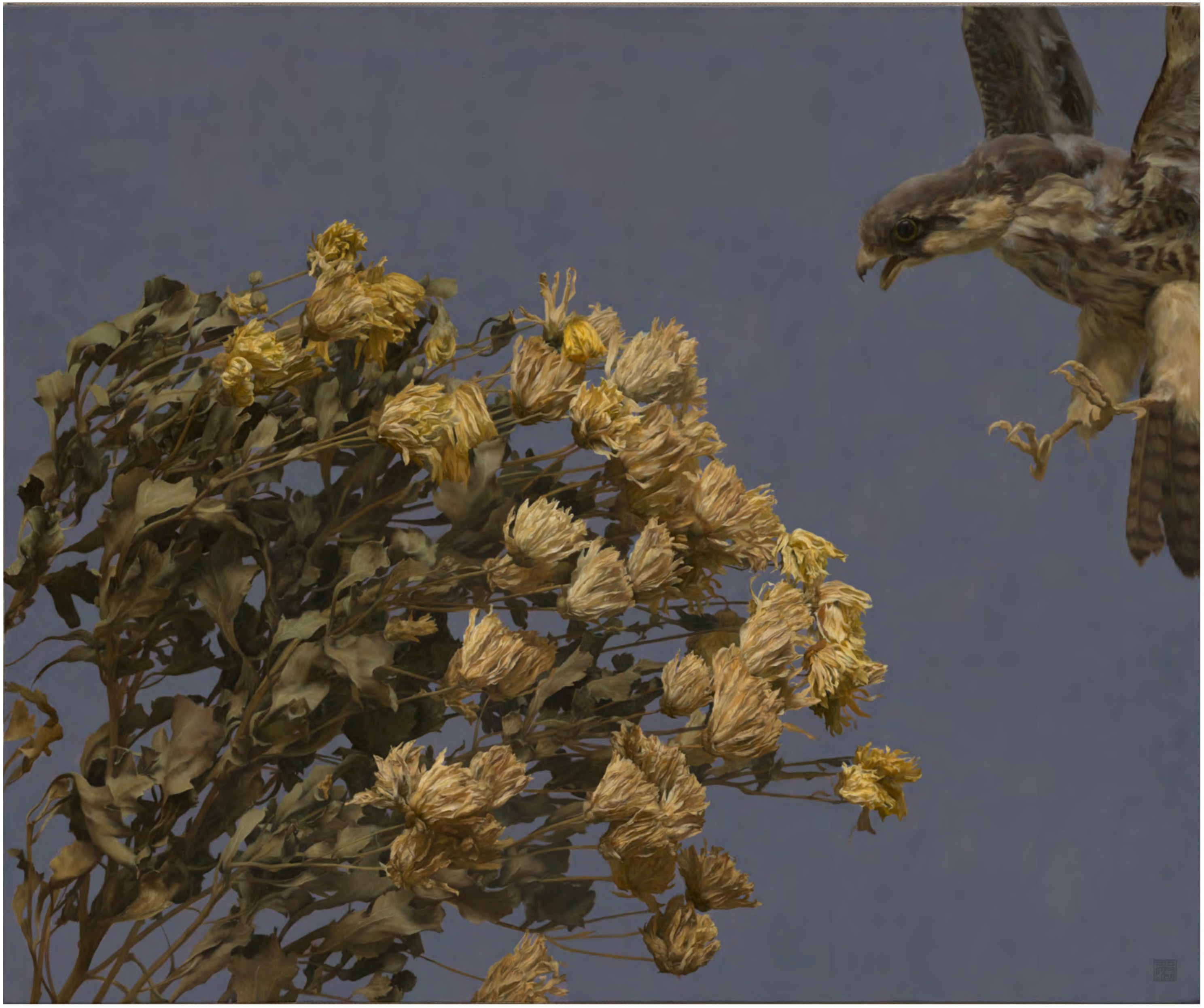
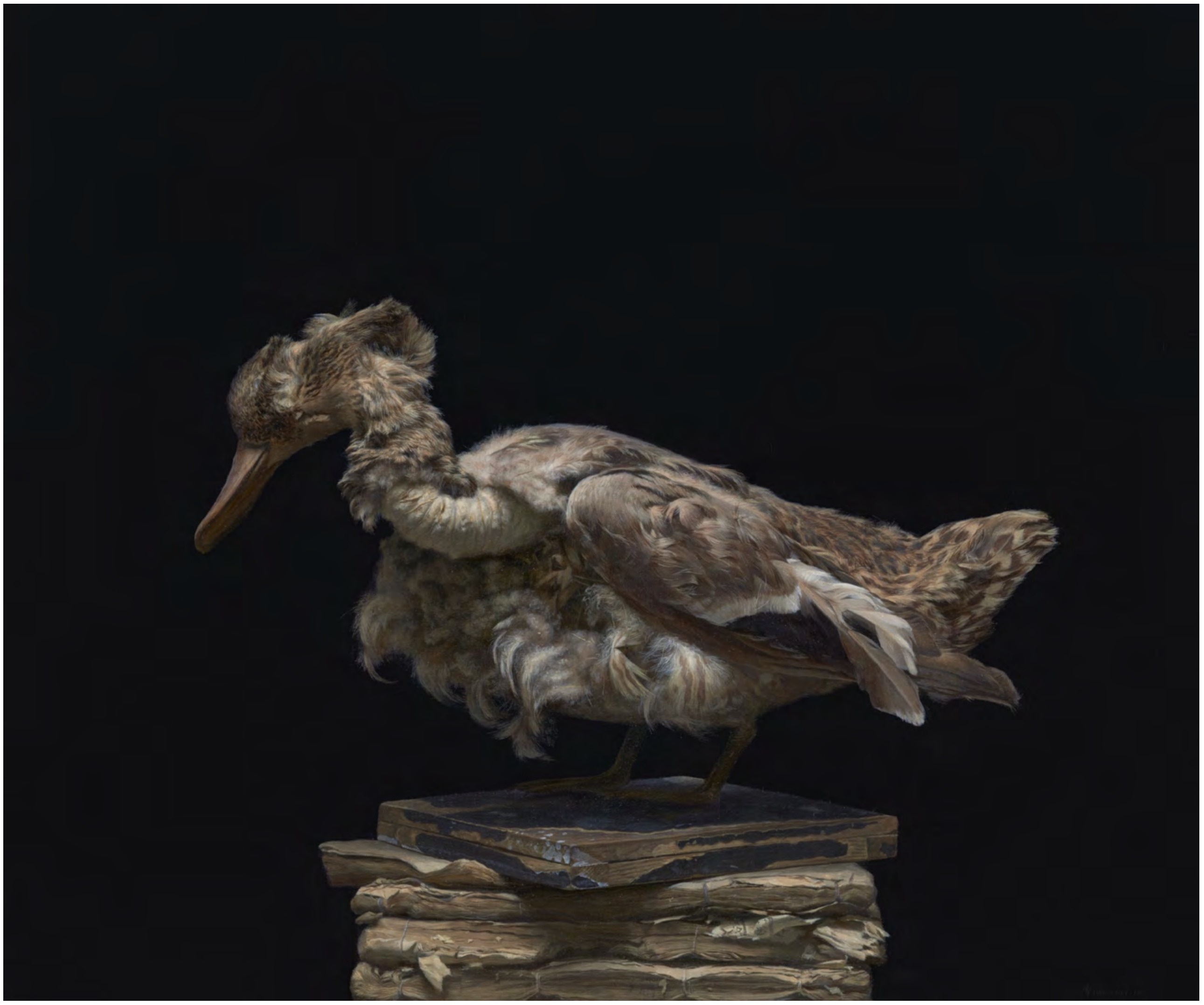
enclosed, self-sufficient, as if the curtain in his work has been drawn in his daily existence. Painting the Dead as if Alive: The Specimen’s Second Life The taxidermied birds Cao paints are, at root, carriers of a posthumous life—objects fashioned into a “second life” that nonetheless succumb to gradual decay. Cao confronts this paradox directly: these specimens are “made to look alive” yet are fundamentally deprived of freedom; their most eloquent, dynamic gestures are arrests of what was once motion and now can only simulate it. This second life is charged with tension—stillness imbued with the possibility of disintegration, feathers powdered by time. Cao seeks to arrest a moment: he will render the feather’s original hue, then overlay a veil of grey to suggest dust deposition. Such gestures echo the specimen’s material entropy while proposing the painted surface as an alternative site for life-processes. He also acknowledges that painting itself ages—
pigments alter, surfaces mature—so painting becomes a field for seeking the “immutable”
that nevertheless remains bound to temporal flux. One often overlooked material fact is that the eyes of standardized specimens are not original organs but artificial implants of glass or plastic. For birds, vision is the principal modality of encounter; the eye stands as the
“window of the soul.” When living tissue decays rapidly after death, taxidermists substitute prosthetic eyes—an unavoidable technical solution that nevertheless constitutes an ethical and symbolic fissure: the manufactured gaze replaces a once-authentic sight.
T h i s s u b s t i t u t i o n p ro d u c e s te m p o ra l dissonance. Taxidermy already represents a first, human-inflected act of creation; when the artist removes a specimen from a collection and remakes it on canvas, a second act of creation is layered on top. Cao’s painted renditions often reinstate the eye as an animate organ, conjuring a living look from a hollow prosthesis; the painted eye becomes both sign of gaze and theatrical prop. Viewers therefore experience a doubleness:
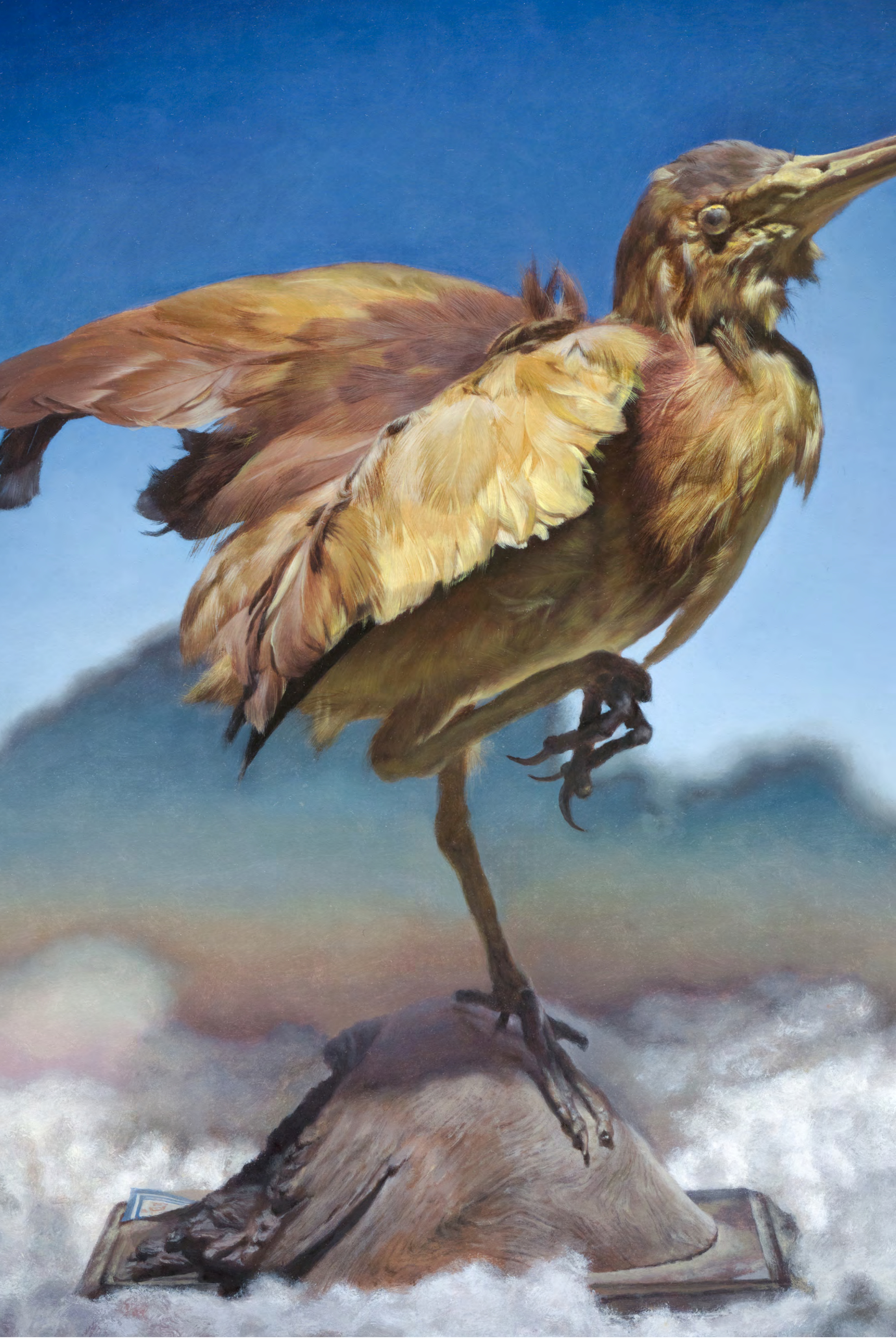
compassion for a once-living creature and unease at seeing that compassion worked into an aestheticized performance. Specimens are not immutable emblems. Even under careful preservation they are subject to insect damage, mold, feather loss, and the cracking or discoloration of their artificial eyes. Their second lives are fragile; sustained exposure in collections can accelerate decline. Cao does not elide this reality; by painting the specimen’s “decay” he insists that preservation is but a temporal postponement and that deterioration continues within the realm of the apparently living. The canvas becomes a simultaneity of times: the specimen’s former vitality, its intervening staged state (production, restoration), and the new moment created by Cao’s painting coexist upon the same surface. The ethical stakes of this double creation surface in works such as Above the Clouds
(2025). There Cao places a base and a cloud together in the pictorial field, a paradox of
“lightness carrying weight”; the specimen’s shadow compresses an infinite distance into a tactile near-plane, the sky folded into a pictorial wall. The specimen’s arrested pose—
seeming either to have just completed a motion or to be on the verge of one—casts a static object into a horizon of potential movement. The image functions as a solo performance: one actor, multiple suggested spatial narratives and an implied audience. Cao does not simply reproduce the specimen; he situates it in places it can never inhabit—
Above the Clouds, Distant Sea (2025), Thousands of Peaks —and thereby redirects the viewer from asking “what is this specimen?” to asking “where has it never been?” The painterly reanimation is thus at once miraculous and absurd: human craft remakes an organism for the gaze, revealing the entanglement of human will and natural agency. Beneath the Curtain: Still Life as Theater Cao sets specimens and Taihu stones before red drapery, creating a field that sits between still life and theater. The red curtain is more than a compositional patch; it is a signifier of ritual and dramaturgy—announcing a solo performance and continuing a lineage of Western academic painting in which sumptuous drapery foregrounds portraiture, still life, and myth. In the tradition of Fontainebleau School, red fabric underscored nobility and ceremony; in seventeenth-century Dutch painting animals as table fare signified bourgeois prosperity; in eighteenth-century Britain, game scenes denoted landed prestige. Cao’s birds and stones become surrogates of such curiosities, while the red curtain functions both as proscenium and as an index to something behind the scene. Leon Battista Alberti’s idea of painting as a
“window” opening onto the world is useful here: the curtain introduces another layer between the viewer and the picture’s narrative. Cao’s curtained stage setting prompts the spectator to interrogate the relation between concealment and revelation. The curtain should not distract; instead, its very presence invites curiosity—what occupies the space it masks?
The dramaturgical staging therefore functions as a critical device: by partially masking, the painting invites a reflective viewing that questions painting’s fidelity to reality. In Cao’s work, the curtain’s silence becomes audible; the viewer is placed at the threshold between actuality and illusion.
Conclusion: Completing the Solo Performance This exhibition’s installation strategy extends the pictorial concerns into the gallery’s architecture. Eight paintings are shown: the Formless series (three canvases) displayed together, and the remaining works each given an individual encounter. The curatorial logic privileges a mode of “looking one painting at a time.” The existing structural columns in the gallery are complemented by three additional non-load-bearing display pillars. The four-pillar ensemble at the room’s core delineates a stage-like precinct: though only two columns are structural, the added “useless”
pillars participate symbolically—they ask what counts as support, what is merely display. This architecture echoes the curtain tradition in the paintings and frames viewing as a guided, bounded act: spectators are both witness and co-narrators, called upon to imagine the story that each picture truncates. We accept that the specimen’s posture has been artfully contrived, and we fill in its missing trajectory—
where will the caged bird fly? What inward reflection does the rock suggest? The viewer’s interpretive completion becomes both assent to Cao’s second act of creation and a further objectification—a rhetorical re-presentation—
of the displaced subject. Cao Kuo occupies a distinct niche between representation and the surreal. His still lives are not a surrender to conceptual painting; rather, they pose rigorous questions in the language of materiality and staging. In a moment when ideas often dominate form, Cao’s return to tactile detail functions as a critical gesture: the re-engagement with the physicality of objects can itself become a mode of critique. Each painting ultimately reads as a monodrama—
one actor, multiple insinuated spaces, audiences, and times—continually interrogating the politics of seeing and the authority of display.
参展艺术家Artists
作品