偏光笔记
展览信息
前言Introduction
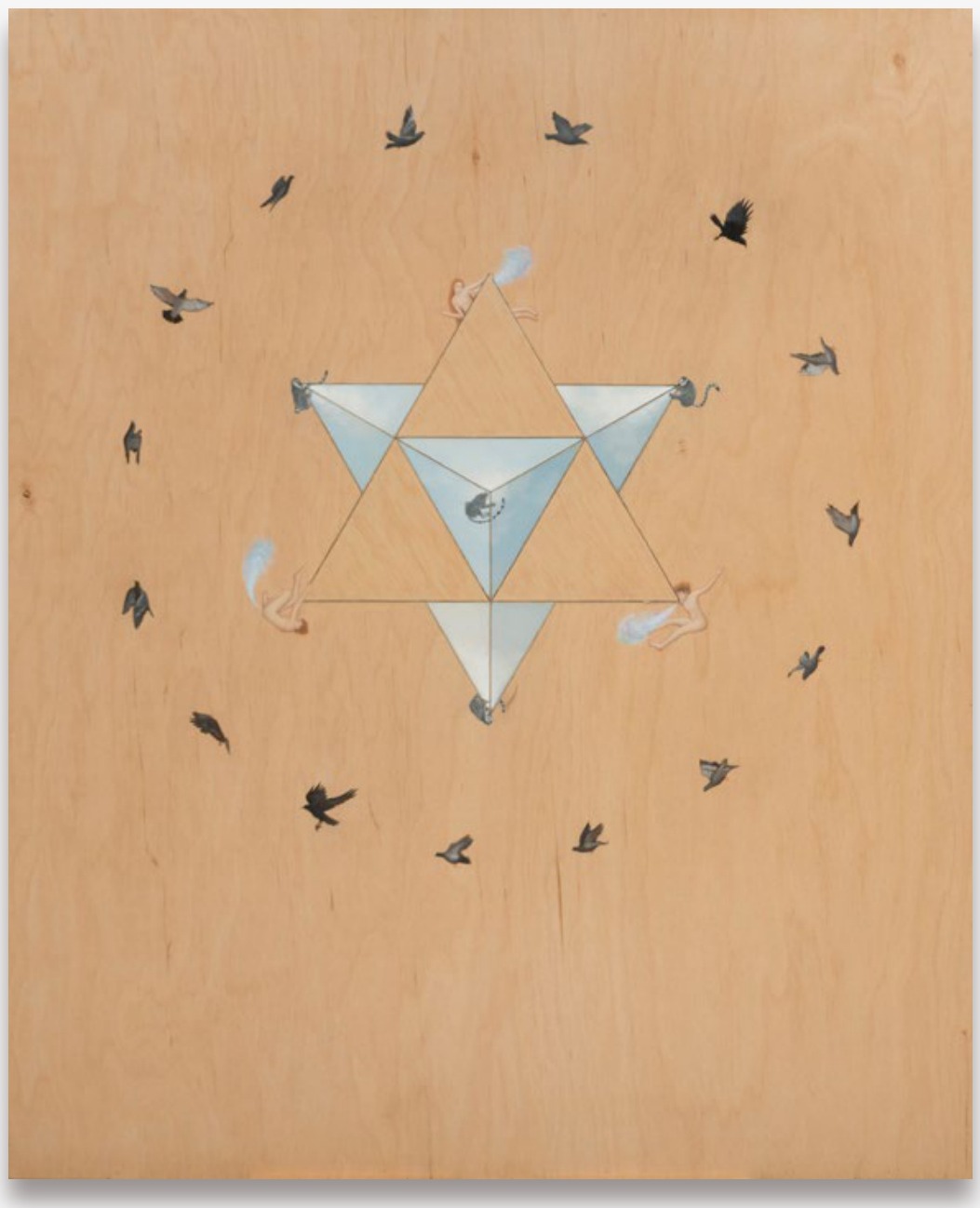
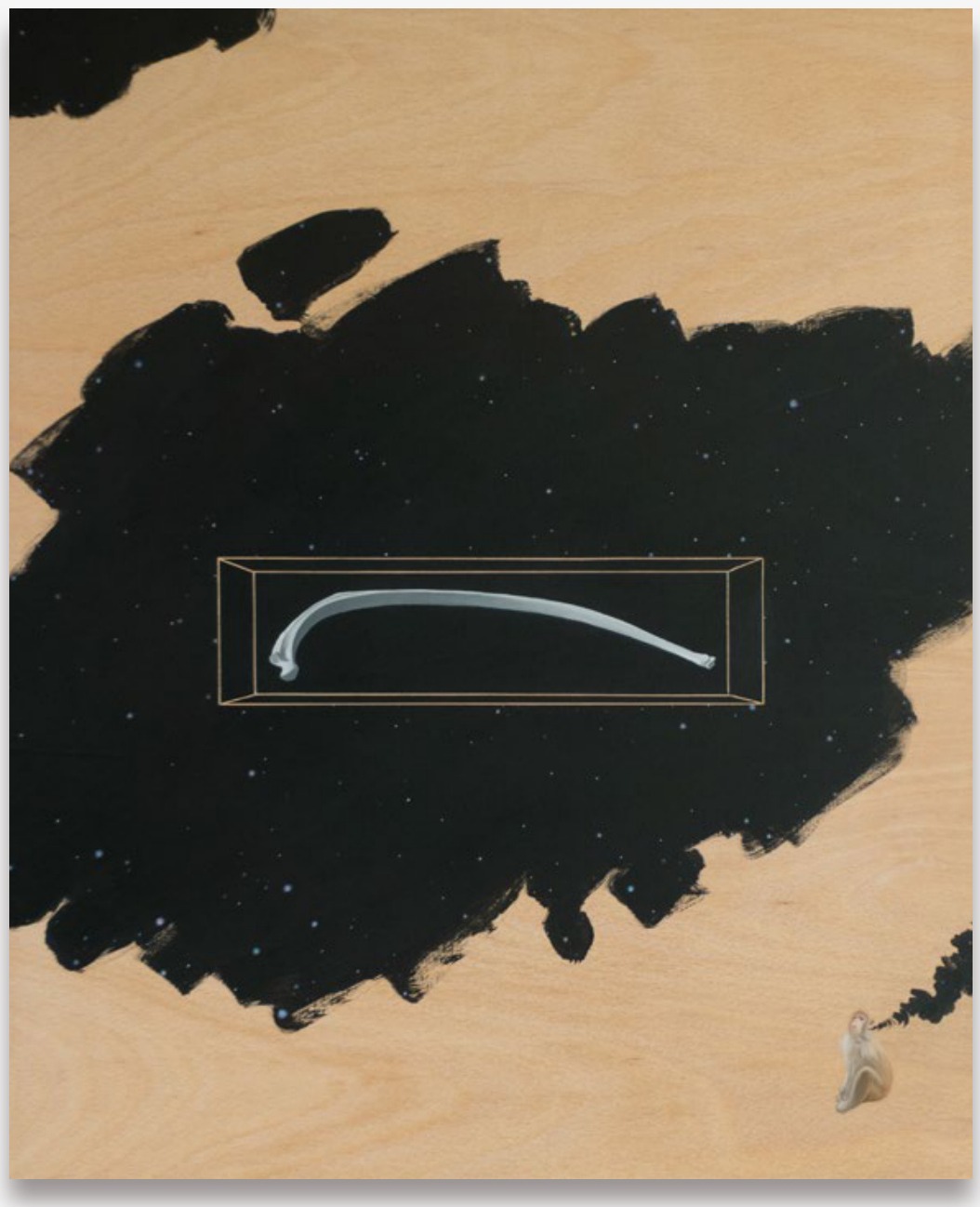
编号“533.022”的《空气动力学- 初始模型》或许可以成为我们理解秦妮方法的起点。这是一个完全由她杜撰的世界起源:画面中心是一个由多个三角形构成的几何体,宛如神圣水晶般稳定,但维系这个“世界模型”运转的,却并非理性或法则,而是一系列荒诞的生命行为:环绕边缘的小猴子不断吹气,呼出的云气成为内部风景的原始物质;三位漂浮的如风神或天使般的人物,却以“放屁”的方式推动着结构旋转;而在环绕的鸟群中,艺术家又悄悄混入两只乌鸦,为看似和谐的系统注入了不祥与混乱。这个宇宙模型因此成为一个表面精密,内核却荒诞的悖论,所谓“世界起源”本身就是一种被注入谎言的个人的神话。如果说“533.022”戏谑地制造了一个“世界的原点”,那么编号《“305.409” 无人校对》则是秦妮对被建构的历史背后的权力话语的审视。画面中心,一根孤零零的肋骨被封装在透明矩形中,如同展柜里的化石。它直接指向《圣经》中“夏娃由亚当肋骨而生”的创世叙事——一个确立女性在西方文明中“第二性”地位的文化起点。秦妮将其抽离原有语境,悬置于深邃的黑色星空中,成为等待被重新审视的“历史物证”。在画面的角落,一只微小的猴子正吐出黑色的烟雾,那烟雾最终汇入包裹肋骨的“黑夜”。个体的低语生成了宏大的历史背景,而这历史又反过来框定了起源的物证。女性的历史,就像一段
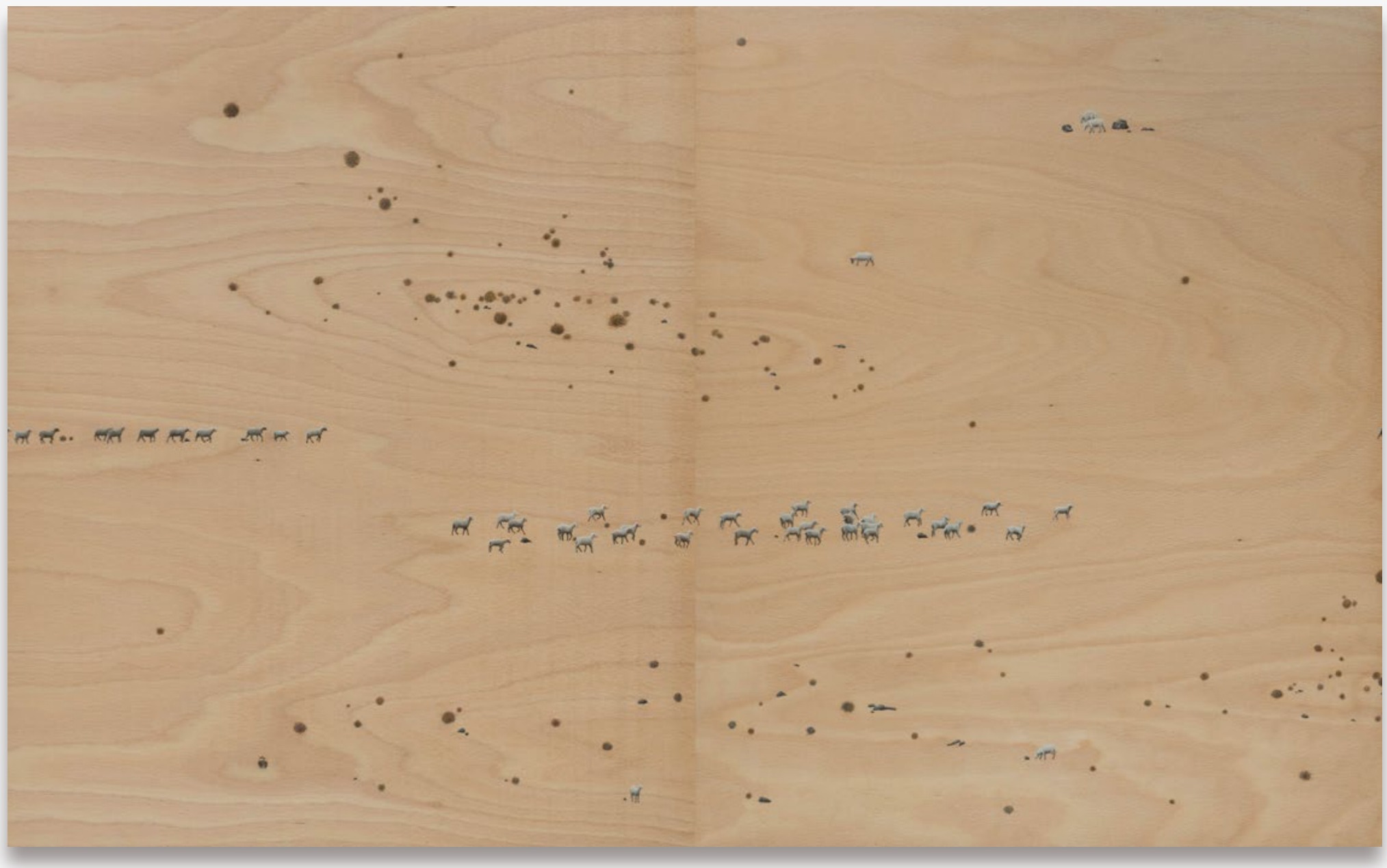
“无人校对”的文本,被宏大的叙事书写、覆盖,却始终潜伏着被重新解读的可能。正因如此,秦妮超越了单纯的解构,转而致力于一种建设性的虚构,她以个人编码重构历史,却又清醒地意识到所有叙事天然的临时性与开放性,不志在成为新的“全能建构者”,而是作为一名谦卑的观测者,主动为认知保留未完成与悬置的状态:一方面严谨地建立框架,另一方面又刻意留出裂隙,让那些不可控、不可编码的自然痕迹——例如原始的“木纹”——成为画面中更具主宰性的存在。这种认知姿态,最终凝结于一个极具身体性的动作:用刀刻划。它既是绘画中的物质性留痕,更是对秩序与表象的主动解蔽。通过刀锋的介入,那片被颜料和符号所“遮蔽”的木纹被强行地重新暴露出来,成为对任何系统性建构的持久嘲讽与提醒。同样地,在展览的同名作品“521.11”《偏光笔记》中,羊群的迁徙逻辑被置换于一片如同荒漠或星尘的广阔木板之上。微小的羊群、星散的石块与飘荡的风滚草,依循天然木纹那星云般的轨迹分布,共同构成一个福柯所说的“异托邦”(hétérotopie)——一个压缩了无尽时空的异质空间。在此,植物的生灭、动物的徙途与地质的永恒彼此并置,一切秩序的游牧,最终仍须回归这片混沌而博大的自然基底得以显影。木纹如同宇宙深处的背景噪音,是前语言的、拒绝被编码的“无所不包的意义之海”;它默然承载所有精心建构的秩序游戏,并以其自在的流淌,提醒着人类一切系统与分类的有限与短暂。撰文:高雨萌
BONIAN SPACE is pleased to present The Polarized Chronicle, a solo exhibition by QIN Ni, on view from September 13 to October 12, 2025. The exhibition features more than twenty panel paintings created since 2022.
“Polarization” refers to the process by which diffuse, chaotic natural light is disciplined through a filter into light vibrating in a single, ordered direction. QIN Ni has internalized this principle as an operative logic. She subjects the dispersive and contingent materials of memory, history, and quotidian imagery to a coding system of her own invention—appropriated and fictively extended from the Dewey Decimal Classification—through which they are selected, recomposed, and inscribed. In this way she constructs a personal ethics of seeing and a narrative strategy, allowing the submerged stories obscured by surface orders to reappear within her works.
“My entire practice is about building a secret passage filled with lies between two seemingly opposed forms: ‘story’ (histoire) and ‘History’ (Histoire).” — QIN Ni QIN Ni’s artistic genealogy can be traced to a distinctly Foucauldian point of departure: a suspicion toward classificatory systems of knowledge and an interrogation of their limits. Foucault himself famously began his archaeology of Western epistemes upon reading Borges’s citation of a fictive “Chinese encyclopedia,” where animals are taxonomized into categories such as “belonging to the emperor,” “smeared with camphor,” or “resembling flies from afar.” What elicited his laughter was the sudden collapse of epistemic ground—the destabilization of the “common place”
of thought. From this rupture Foucault discerned a truth: that no classificatory system is neutral, but always serves a latent worldview and structure of power. QIN Ni’s practice unfolds as a self-reflexive and parodic “archaeology of knowledge.” In Foucauldian terms, “natural light” corresponds to the diffuse field of countless statements (énoncés)
that circulate in history and society: unorganized, scattered, vibrating in all directions. This is the pre-archival state, the raw matter of discourse—charged with potentiality, but saturated with noise. As Foucault insists, a statement is not a sentence or proposition but a function: it may appear as a painting, a map, a formula, or an architectural fragment. Its significance lies not in what it “expresses” but in how it functions within a discursive system. It is in precisely this sense that QIN Ni constructs her personal system. The library classification epitomizes humanity’s rational ambition to compress the infinite and chaotic world into a finite, ordered framework of knowledge. By appropriating the most authoritative of such tools—
the Dewey Decimal Classification—and continually forging within it, she transforms it into a pseudo-taxonomic grammar. If “natural light” is the unbounded multiplicity of statements, then in her work “polarized light” designates the ordered set of statements filtered through this fictive Deweyan lens and subsumed into her personal archive. QIN Ni: The Polarized Chronicle Text by GAO Yumeng
This archive interlaces genuine indexical entries with codes of her own invention. Her paintings thus become sites where “relations” and “rules” take form. They do not depict meaning perse, but reveal the processes by which things are named, classified, misread, and ultimately sedimented into memory. In this new series, she abandons narrative scenes in favor of inscribing statements directly: arranging images as one might arrange textual entries. Each work is no longer a discrete image but a statement—its significance inheres less in isolated content than in its function within the system and its resonances with other statements. The work “533.022” Gas Mechanics – Initial Model may serve as an entry point into QIN Ni’s method. At the center of the panel, a crystalline polyhedron of interlocking triangles appears as stable as sacred geometry. Yet what animates this “world model” is not law or reason but absurd life-forces: tiny monkeys encircling its edges exhale clouds that form the raw material of inner landscapes; three airborne figures—half wind-god, half angel—propel the structure by comically flatulent means; among the circling flock of doves, two black crows are discreetly inserted, injecting discord into apparent harmony. This cosmological schema is thus rendered paradoxical:
precise in appearance, absurd in substance, exposing “world origin” itself as a personal mythology laced with lies. If “533.022” parodically fabricates a cosmic origin, then “305.409” Unproofed interrogates the discursive power behind historical origin myths. At its center, a solitary rib is enshrined in a transparent vitrine-like rectangle, evoking a fossil on display. The symbol points directly to the Biblical narrative of Eve fashioned from Adam’s rib—the foundational myth of woman’s
“secondary” status within Western civilization. Qin Ni extracts the rib from its originary context and suspends it within a deep black firmament, transfiguring it into a “historical specimen”
awaiting re-examination. In the lower corner, a diminutive monkey exhales black smoke that ascends to envelop the rib. The whispers of the individual generate a cosmic backdrop of history, which in turn frames the evidence of origin. Women’s history, the work suggests, resembles a text “without proofreading”—constructed and overwritten by grand narratives, yet always retaining the potential for re-reading and revision. In this way, QIN Ni exceeds the gesture of deconstruction, committing herself instead to a constructive fiction. She re-codes history through her personal taxonomy, yet remains acutely aware of the provisional and open-ended condition of all narratives. She refuses the role of
“master-builder,” positioning herself instead as a humble observer who deliberately suspends closure: on one side rigorously establishing frameworks, on the other leaving fissures through which uncontrollable and unclassifiable traces of nature—such as the raw grain of wood—assert themselves as sovereign presences. This cognitive stance ultimately crystallizes into a deeply physical gesture: carving with a knife. It is at once a material trace within the painting and, more profoundly, an act of active unconcealment against order and appearance. Through the intervention of the blade, the wood grain—that which was "concealed" by pigment and symbol—is forcefully re-exposed, becoming a persistent mockery and a reminder against any systematic construction. The exhibition’s eponymous work, “521.11” Polarization Notes, again crystallizes this stance. Across a vast wooden panel resembling desert terrain or stellar dust, the logic of sheep migration is displaced. Tiny flocks, scattered stones, drifting tumbleweeds, and the nebula-like trajectories of natural wood grain converge into what Foucault termed a “heterotopia”—a heterogeneous space compressing infinite temporalities into a single field. Here, vegetal cycles, animal migrations, and geological permanence are juxtaposed; yet every human ordering of movement ultimately returns to the primordial substrate of wood grain to be inscribed. The grain itself functions as the background noise of the cosmos: pre-linguistic, resistant to codification, an ocean of meaning that encompasses all. It silently bears the games of order and classification, and through its ungovernable flow, reminds us of the limits and transience of all human systems.
参展艺术家Artists
作品